In a recent sermon, John Huffman shares this: "The September 12, 2005, issue of The New Yorker has a profoundly observant article about Saddleback Church and how Rick Warren's congregation grew. It's titled, 'The Cellular Church.' After describing the phenomenon of Rick Warren's ministry, the success of his book, The Purpose-Driven Life, and the huge mega-church he's built here in South Orange County, the author, Malcolm Gladwell, becomes quite philosophical. He notes that vibrant churches hold one thing in common, no matter how small or large they are. They basically are made up of 'small groups' of committed people who know each other and are united in a common commitment. He quotes philosopher Dick Westley, who writes:
As I see it, one of the most unfortunate misunderstandings of our time has been to think of small intentional communities as groups "within" the church. When are we going to have the courage to publicly proclaim what everyone with any experience with small groups has known all along: they are not organizations "within" the church; they are church.
The article goes on to note the church in the United States is becoming increasingly active in producing volunteers who are bringing change to our environment. Princeton sociologist Robert Wuthnow, who has studied the phenomenon closely, says:
Small groups are networks . . . They create bonds among people. Expose people to needs, provide opportunities for volunteering, and put people in harm's way of being asked to volunteer. That's not to say that being there for worship is not important. But, even in earlier research, I was finding that if people say all the right things about being a believer but aren't involved in some kind of physical social setting that generates interaction, they are just not as likely to volunteer."
(From e-news, www.preaching.com)
Wednesday, November 02, 2005


Tuesday, October 25, 2005
does it work?
A while ago I decided to try and get my head around the world of philosophy. I've been reading books and listening to CD's and my current conclusion is that there is really only one final criteria for establishing truth, here is my go.
- Can what you believe be lived?
- The person who says that everything is a dream still looks both ways before crossing the road.
- The person who says the are no absolutes is absolutely sure that this is true.
- The person who says we are merely products of time + chance still tells his wife he loves her and means something more than just a biological upheaval is happening.
- The person who says there is no right or wrong still gets upset when I steal her wallet.
In the end I've come to this conclusion. The worldview of the bible is the worldview that makes most sense of the world in which I live, and I find I can live consistently with it. The biblical worldview acknowledges there is evil in the world, it speaks of the reality of truth and emotion, it speaks of the value of hope, and it gives a solution to the problem of sin.
If someone were to show me a worldview that makes more sense of real life then I would seriously consider it, for now I'm more committed to being a follower of Jesus Christ than ever.
mates blogs
A mate of mine has joined the blog bandwagon, here are the sites of his two blogs. http://rocksnob.blog.com andhttp://christianityorbust.blog.com
christian guys seeking christian girls
A common question I get asked is where can I Christian guy meet a Christian girl, well here is a recommended website, from someone who it worked for. www.christianconnection.com.au
best writer
In my humble opinion I reckon Tom Peters is the best business writer I've come across. Just reading his book "Leadership" which is part of his essentials series. Every time I read Tom Peters I get inspired and provoked. His books are some of the few that I re-read. If you want to operate at a different level then pick up his books and be prepared to have your current reality challenged. He might annoy the heck out of you and you might vermently disagree with some of his ideas, but you will be made to think - think about that!
Monday, October 24, 2005
volunteer resources
Here's a website with some good resources working with volunteers. http://www.energizeinc.com/
useful resources
Need good quality photo's at a reasonable price? Check out http://www.istockphoto.com/
Need a program that will screen capture what you want and not the whole screen? Check out www.snagit.com
Need a program that will screen capture what you want and not the whole screen? Check out www.snagit.com
Sunday, October 23, 2005
giving stories
Check out this website for some excellent stories on giving. http://www.epm.org/articles/givingstories.html
generosity steps
(This is somewhat American but has some excellent ideas about the stages of giving.)
The Stages of Giving by Kenneth N. Dayton from “The Stages of Giving,” Independent Sector, 1999.
Dayton identifies nine stages of giving, based on his personal experiences with philanthropy:
1. Minimal Response: Giving because we were asked and only because we were asked.
2. Involvement and Interest: You believe in the cause and you want to make it better. It becomes meaningful and purposeful.
3. As Much As Possible: A major transformational breakthrough that requires thinking, a budget and priorities.
4. Maximum Allowable: The IRS five-year carry-forward provision gave us an opportunity to plan and to think creatively about our philanthropy. It meant we could initiate projects.
5. Beyond the Max: We ignored the IRS maximum and began to give what we wanted to give. The second breakthrough, we decided we would no longer let the IRS tell us how much (or how little) we could give.
6. Percent of Wealth: If one no longer measures giving against income or income tax deductibility, logic soon leads to using total wealth as a measure. Until we started to measure our giving against our wealth, we did not fully realize how much we could give away and still live very comfortably.
7. Capping Wealth: How wealthy do we want to be? This means setting a limit on your wealth and giving away everything you earn beyond that figure.
8. Reducing the Cap: We are not there yet. Whether we will ever have the courage and fortitude and intelligence to lower the cap as we get older we cannot say. But, we are comfortable discussing the subject.
9. Bequests: Long ago we decided we had transferred enough of our assets to our heirs. Accordingly, we are able to leave almost all of our assets to the nonprofit organizations we have selected.
The Stages of Giving by Kenneth N. Dayton from “The Stages of Giving,” Independent Sector, 1999.
Dayton identifies nine stages of giving, based on his personal experiences with philanthropy:
1. Minimal Response: Giving because we were asked and only because we were asked.
2. Involvement and Interest: You believe in the cause and you want to make it better. It becomes meaningful and purposeful.
3. As Much As Possible: A major transformational breakthrough that requires thinking, a budget and priorities.
4. Maximum Allowable: The IRS five-year carry-forward provision gave us an opportunity to plan and to think creatively about our philanthropy. It meant we could initiate projects.
5. Beyond the Max: We ignored the IRS maximum and began to give what we wanted to give. The second breakthrough, we decided we would no longer let the IRS tell us how much (or how little) we could give.
6. Percent of Wealth: If one no longer measures giving against income or income tax deductibility, logic soon leads to using total wealth as a measure. Until we started to measure our giving against our wealth, we did not fully realize how much we could give away and still live very comfortably.
7. Capping Wealth: How wealthy do we want to be? This means setting a limit on your wealth and giving away everything you earn beyond that figure.
8. Reducing the Cap: We are not there yet. Whether we will ever have the courage and fortitude and intelligence to lower the cap as we get older we cannot say. But, we are comfortable discussing the subject.
9. Bequests: Long ago we decided we had transferred enough of our assets to our heirs. Accordingly, we are able to leave almost all of our assets to the nonprofit organizations we have selected.
Thursday, October 20, 2005
christian book summaries
If you would like to keep up to date with good recent Christian books this is a useful website. http://www.christianbooksummaries.com/
so what are we aiming at?
Sitting here and it's 11.30pm and I'm just conjugating. (Is that a word?)
I've been reading "Leadership" by Tom Peters and I've been challenged, provoked, pushed, shoved into thinking about my core ministry value/goal.
I ask myself the question about what is it that I'm aiming for?
I ask myself that if I was allowed only one goal what would it be?
I ask myself what is it I want on my tombstone in regard to my ministry?
Here it is, this is my heartbeat, this is my passion, this is what I'm prepared to give my life for.
"To create small group communities of 5 Jesus followers who gather weekly for the express purpose of loving God and each other and who are committed to do whatever is needed to grow to 10 Jesus followers within the next 12 months, then multiply and do it again."
In my opinion this is the most important important and most transforming thing the church can do. If this is all the church did it would please God.
I've been reading "Leadership" by Tom Peters and I've been challenged, provoked, pushed, shoved into thinking about my core ministry value/goal.
I ask myself the question about what is it that I'm aiming for?
I ask myself that if I was allowed only one goal what would it be?
I ask myself what is it I want on my tombstone in regard to my ministry?
Here it is, this is my heartbeat, this is my passion, this is what I'm prepared to give my life for.
"To create small group communities of 5 Jesus followers who gather weekly for the express purpose of loving God and each other and who are committed to do whatever is needed to grow to 10 Jesus followers within the next 12 months, then multiply and do it again."
In my opinion this is the most important important and most transforming thing the church can do. If this is all the church did it would please God.
leadership
"A leader is a dealer in hope." - Napolean
"The first task of a leader is to keep hope alive." - John Gardner
"The first task of a leader is to keep hope alive." - John Gardner
Wednesday, October 19, 2005
spiritual maturity
In The Final Quest, Rick Joyner writes, "Spiritual maturity is always dictated by our willingness to sacrafice our own desires for the desires of others or for the interests of the kingdom."
(Every Man's Battle, P.183)
(Every Man's Battle, P.183)
Tuesday, October 18, 2005
it takes discipline
No horse ever gets anywhere until he is harnessed. No steam or gas ever drives anything until it is confined. No Niagara is ever turned into light and power until it is tunneled. No life ever grows great until it is focused, dedicated, disciplined.— Harry Emerson Fosdick
I've never known a man worth his salt who in the long run, deep down in his heart, didn't appreciate the grind, the discipline. … I firmly believe that any man's finest hour—this greatest fulfillment to all he holds dear—is that moment when he has worked his heart out in a good cause and lies exhausted on the field of battle victorious.— Vince Lombardi
Life is tons of discipline.— Robert Frost
I've never known a man worth his salt who in the long run, deep down in his heart, didn't appreciate the grind, the discipline. … I firmly believe that any man's finest hour—this greatest fulfillment to all he holds dear—is that moment when he has worked his heart out in a good cause and lies exhausted on the field of battle victorious.— Vince Lombardi
Life is tons of discipline.— Robert Frost
the most challenging verse
God has time and time brought me back to John 15:7 which says, "If you remain in me and my words remain in you, ask whatever you wish, and it will be given you."
More and more I'm realising the depth and meaning of the word "if" and the words "remain in me". The promise of answered prayer is conditional on my part. I'm coming to the conclusion that the powerlessness of most prayer (including my own) is simple because I/we have not discovered what it really means to remain in Jesus.
"Lord help me today make choices and take steps of obedience that ensure that I remain in you more and more."
More and more I'm realising the depth and meaning of the word "if" and the words "remain in me". The promise of answered prayer is conditional on my part. I'm coming to the conclusion that the powerlessness of most prayer (including my own) is simple because I/we have not discovered what it really means to remain in Jesus.
"Lord help me today make choices and take steps of obedience that ensure that I remain in you more and more."
holiness
[As a follower of Jesus Christ] holiness is not some nebulous thing. It's a series of right choices. You needn't wait for some holy cloud to form around you. You'll be holy when you choose not to sin. You're already free from the power of sexual immorality; you are not yet free from the habit of sexual immorality, until you choose to be - until you say, "That's enough! I'm choosing to live purely."
(Every Man's Battle, P.92)
(Every Man's Battle, P.92)
man or sissy?
When it comes down to it, God's definition of real manhood is pretty simple: It means hearing His Word and doing it. That's God's only definition of manhood - a doer of the Word. And God's definition of a sissy is someone who hears the Word of God and doesn't do it.
(Every Man's Batte, P.77)
(Every Man's Batte, P.77)
a book every man should read
There is a book every man should read called "Every Man's Battle" by Stephen Arterburn & Fred Stoeker.
From the television to the internet, print media to videos, men are constantly faced with the assault of sensual images. It is impossible to avoid such temptations ... but, thankfully, not impossible to rise above them.
Shattering the perception that men are unable to control their thought lives and roving eyes, Every Man's Battle shares the stories of dozens who have escaped the trap of sexual immorality and presents a practical, detailed plan for any man who desires sexual purity - perfect for men who have fallen in the past, those who want to remain strong today, and all who want to overcome temptation in the future.
From the television to the internet, print media to videos, men are constantly faced with the assault of sensual images. It is impossible to avoid such temptations ... but, thankfully, not impossible to rise above them.
Shattering the perception that men are unable to control their thought lives and roving eyes, Every Man's Battle shares the stories of dozens who have escaped the trap of sexual immorality and presents a practical, detailed plan for any man who desires sexual purity - perfect for men who have fallen in the past, those who want to remain strong today, and all who want to overcome temptation in the future.
Monday, October 17, 2005
in my view (23 oct 2005)
In my view the final test of what we do here at CMP is whether people are coming to know, love and obey Jesus as a result of what we do.
We’ve been using the theme connect@cmp ... with God ... with Self ... with Other to describe this idea and I would ask that you spend time praying on a regular basis for us as a congregation that we would be used by God to achieve these three things.
Imagine a time in the life of CMP when on a weekly basis we have people testifying that they have come to know Jesus for the first time through the ministry of CMP.
Imagine a time when on a daily basis we hear stories of people’s lives being transformed as they walk in deeper obedience out of a deep sense of love for God.
Imagine a time when the community in which we live talks about CMP as the place where people truly love one another and so is a beacon for the love and grace of God.
The truth is, some of this is already happening, but as we continue to reach out to others, this will become a greater and greater reality in the life of our congregation.
May this week we be a blessing to the world in which we live.
We’ve been using the theme connect@cmp ... with God ... with Self ... with Other to describe this idea and I would ask that you spend time praying on a regular basis for us as a congregation that we would be used by God to achieve these three things.
Imagine a time in the life of CMP when on a weekly basis we have people testifying that they have come to know Jesus for the first time through the ministry of CMP.
Imagine a time when on a daily basis we hear stories of people’s lives being transformed as they walk in deeper obedience out of a deep sense of love for God.
Imagine a time when the community in which we live talks about CMP as the place where people truly love one another and so is a beacon for the love and grace of God.
The truth is, some of this is already happening, but as we continue to reach out to others, this will become a greater and greater reality in the life of our congregation.
May this week we be a blessing to the world in which we live.
Sunday, October 16, 2005
bible resource
Here's an excellent bible resource. Particularly interesting is "The Theology Program" which has video clip answers to many questions, check it out.
Saturday, October 08, 2005
create your own ring tones
I was looking a ring tones and decided that rather than pay for new ones it would be better to make my own. Here is how I did it. (Assuming you can connect your phone to your computer - mine is an O2.)
(1) Grab some freeware audio files such as available at http://simplythebest.net/sounds/MP3/sound_effects_MP3/index.html
(2) Download the file into an mp3 maker programme such as MAGIX mp3 maker.
(3) Convert the file to an mp3 file and save it to a place that you can find the file.
(4) Connect your phone to your computer and then transfer the file into the appropriate folder on your phone. (For me this was: My Pocket PC/Windows/Rings)
(5) Select the ring tone on your phone. (For O2: Settings/Sounds & Notifications/Notifications/1. Select an event/ Phone: Incoming call ... and then select file in the "Ring Tone" drop down menu.)
(6) Have fun with your new ringtones.
(1) Grab some freeware audio files such as available at http://simplythebest.net/sounds/MP3/sound_effects_MP3/index.html
(2) Download the file into an mp3 maker programme such as MAGIX mp3 maker.
(3) Convert the file to an mp3 file and save it to a place that you can find the file.
(4) Connect your phone to your computer and then transfer the file into the appropriate folder on your phone. (For me this was: My Pocket PC/Windows/Rings)
(5) Select the ring tone on your phone. (For O2: Settings/Sounds & Notifications/Notifications/1. Select an event/ Phone: Incoming call ... and then select file in the "Ring Tone" drop down menu.)
(6) Have fun with your new ringtones.
Thursday, October 06, 2005
porn troubles
This is an email I recently received:
Hey Pete, Do you know of any good (international) programs for men struggling with pornography that you know of. I have a friend here, her fiance is he has just admitted he has a problem. She is hoping to help him get into a program but not sure where to start.
Here's my reply:
There is and excellent and free courses available through http://www.settingcaptivesfree.com/home/. (Go to online courses and look for the “Sexual Purity” course. This is a 60 day online teaching and accountability course.)
An excellent and very cheap computer filter is “safeeyes”. (One off fee of US$49.95.) This is the one I use and have found it extremely helpful. http://www.safeeyes.com/safe_eyes/products.htm
Another website worth checking out is www.xxxchurch.com. The name is radical but they are a useful resource.
If someone wants to deal with the issue then the really need to do the course and get the software filter.
If they want to talk then give them my email and I’m happy to chat with them.
Hey Pete, Do you know of any good (international) programs for men struggling with pornography that you know of. I have a friend here, her fiance is he has just admitted he has a problem. She is hoping to help him get into a program but not sure where to start.
Here's my reply:
There is and excellent and free courses available through http://www.settingcaptivesfree.com/home/. (Go to online courses and look for the “Sexual Purity” course. This is a 60 day online teaching and accountability course.)
An excellent and very cheap computer filter is “safeeyes”. (One off fee of US$49.95.) This is the one I use and have found it extremely helpful. http://www.safeeyes.com/safe_eyes/products.htm
Another website worth checking out is www.xxxchurch.com. The name is radical but they are a useful resource.
If someone wants to deal with the issue then the really need to do the course and get the software filter.
If they want to talk then give them my email and I’m happy to chat with them.
Tuesday, October 04, 2005
stewardship
Tony Campolo was invited to address a women's conference where the participants were being challenged to raise several thousand dollars for a mission project goal. While Campolo was sitting on the dais, the chairperson turned to him and asked him if he would pray for God's blessing as they considered their individual responses to the goal. Campolo stood and -- to the utter amazement of everyone present -- graciously said "no."
He approached the microphone and said, "You already have all the resources necessary to complete this mission project right here within this room. It would be inappropriate to ask for God's blessing, when in fact God has already blessed you with the abundance and the means to achieve this goal. The necessary gifts are in your hands. As soon as we take the offering and underwrite this mission project, we will thank God for freeing us to be the generous, responsible and accountable stewards that we're called to be as Christian disciples." And they did.
(PreachingNow email: see www.preaching.com)
He approached the microphone and said, "You already have all the resources necessary to complete this mission project right here within this room. It would be inappropriate to ask for God's blessing, when in fact God has already blessed you with the abundance and the means to achieve this goal. The necessary gifts are in your hands. As soon as we take the offering and underwrite this mission project, we will thank God for freeing us to be the generous, responsible and accountable stewards that we're called to be as Christian disciples." And they did.
(PreachingNow email: see www.preaching.com)
reasons I quit attending football / church
Twelve reasons I quit attending football games -- or did I mean church?
1. Every time I went, they asked me for money.
2. The people sitting next to me didn't seem very friendly.
3. The seats were too hard.
4. The coach (Pastor) never came to call on me.
5. The referee (Deacons) made a decision I disagreed with.
6. I was sitting with hypocrites -- they came only to see what others were wearing.
7. Some of the games/services went into overtime and I was late getting home.
8. The band (Choir) did songs I didn't like.
9. The games/services were scheduled when I wanted to do other things.
10. My parents took me to too many games/churches when I was growing up.
11. Since I read a book about football (religion), I know more than the coaches (pastors) do anyhow.
12. I don't want to take my children, because I want them to choose for themselves what sport (religion) they like best.
(Adapted From otchurch@aol.com by Sermon Fodder; to subscribe go to http://www.sermonfodder.com)
1. Every time I went, they asked me for money.
2. The people sitting next to me didn't seem very friendly.
3. The seats were too hard.
4. The coach (Pastor) never came to call on me.
5. The referee (Deacons) made a decision I disagreed with.
6. I was sitting with hypocrites -- they came only to see what others were wearing.
7. Some of the games/services went into overtime and I was late getting home.
8. The band (Choir) did songs I didn't like.
9. The games/services were scheduled when I wanted to do other things.
10. My parents took me to too many games/churches when I was growing up.
11. Since I read a book about football (religion), I know more than the coaches (pastors) do anyhow.
12. I don't want to take my children, because I want them to choose for themselves what sport (religion) they like best.
(Adapted From otchurch@aol.com by Sermon Fodder; to subscribe go to http://www.sermonfodder.com)
Monday, October 03, 2005
fiji
Recently 16 people from our church travelled to Fiji to help build a home for a widowed lady and her adopted daughter. For six years they had been living under a small makeshift shack. The conditions were so bad I wouldn't put my dog in it, and yet she lived that way for six years.
It was a real honour to be able to build her a new home. The building is just basis, (5 metre by 7 metre room), but it is solid and provides warmth and shelter. The week we spent building is one of the most worthwhile things I ever been involved in. One of our team members has put some photo's up at http://spaces.msn.com/members/micshots/
It was a real honour to be able to build her a new home. The building is just basis, (5 metre by 7 metre room), but it is solid and provides warmth and shelter. The week we spent building is one of the most worthwhile things I ever been involved in. One of our team members has put some photo's up at http://spaces.msn.com/members/micshots/
new addition
 We finally bit the bullet and got the dog we've been promising the kids for a while. His name is Woody (with my daughter Alex) and he is a 2 year old Golden Retriever that we picked up from the pound. It's amazing how quickly life changes when you add someone or something to the family.
Monday, August 29, 2005
chronic fatigue syndrome
Leigh’s story will bring comfort to all those suffering with Chronic Fatigue Syndrome, and will show others how to accept, love and support anyone who is wrestling with this ‘multi-headed beast’.
http://notcrazy.net/
http://notcrazy.net/
in my view 29/08/05
In my view one of the most important and beautifully distinctive features of Christianity is the concept of grace. The reality of grace is an amazing thing to experience. When someone treats me not as I deserve but as God would, then I know I have experienced something truly divine. I am lucky enough to have received grace filled forgiveness a number of times in my personal and ministry life and it is one thing that helps me cling to God when times get tough and rough.
Wouldn’t it be a beautiful thing if CMP was known as a place where grace is practiced in large measure? Wouldn’t it be a magnificent testimony to God if we became known as a people who don’t take offence easily, who forgive quickly and completely, and who choose to view the good and not the bad in each other.
I know that to be the minister at CMP in the years ahead I will require your gracious acts of grace, mercy and forgiveness as I make mistakes. I hope and pray that together we might walk a journey that proclaims loudly and proudly that we are Christians and that it is evident because of our love for each other.
This kind of thing can only happen as we are lovingly honest and upfront with each other, so please don’t hesitate to talk with me if there is something I have done that you’ve been offended by. We may not always agree but I hope that we can learn to love and appreciate each other more as we walk through and not around the difficulties that will inevitably arise.
(Church in the Market Place Newsletter, 04/09/05)
Wouldn’t it be a beautiful thing if CMP was known as a place where grace is practiced in large measure? Wouldn’t it be a magnificent testimony to God if we became known as a people who don’t take offence easily, who forgive quickly and completely, and who choose to view the good and not the bad in each other.
I know that to be the minister at CMP in the years ahead I will require your gracious acts of grace, mercy and forgiveness as I make mistakes. I hope and pray that together we might walk a journey that proclaims loudly and proudly that we are Christians and that it is evident because of our love for each other.
This kind of thing can only happen as we are lovingly honest and upfront with each other, so please don’t hesitate to talk with me if there is something I have done that you’ve been offended by. We may not always agree but I hope that we can learn to love and appreciate each other more as we walk through and not around the difficulties that will inevitably arise.
(Church in the Market Place Newsletter, 04/09/05)
Friday, August 19, 2005
interesting
"If deliberate strategizing is ineffective, then what matters is an abundance of diverse new initiatives from which the environment can select the best. Hannan & Freeman (1988) 'population ecology' perspective suggests that overall effeciency can best be secured by ensuring a steady stream of new entrants into any organizational population, from which the relatively ill-adapted are ruthlessly selected out."
This line from my reading on Strategic Management hit me like a ton of bricks. Think about its implication for organisational life. The key thought is not that we have to hit upon the 'right answer', but that by allowing lots of new initiatives we increase the likelihood of good ideas happening, as long as we protect resources by 'ruthlessly getting rid of ill-adapted initiatives.
This line from my reading on Strategic Management hit me like a ton of bricks. Think about its implication for organisational life. The key thought is not that we have to hit upon the 'right answer', but that by allowing lots of new initiatives we increase the likelihood of good ideas happening, as long as we protect resources by 'ruthlessly getting rid of ill-adapted initiatives.
Monday, August 15, 2005
a tongues experiment
Today I sought advice from a true man of God. I was asking how to experience God more deeply and his advice was ridiculously simple. His advice to me was to spend 10 minutes a day worshipping God aloud in tongues. I have committed myself to do this for the next month and see how it impacts my life. If there is one thing I've discovered its this, if someone is further on than me then I will listen and obey their advice no matter how simple or strange it may seem.
provoking thoughts
LIFE TODAY WITH JAMES ROBISON>>>>>>Last Tuesday we taped 2 episodes of "Life Today" with James Robison and his wife Betty. We hopped on the plane Tuesday morning and headed out to Dallas, TX. Usually we don't like to do Christian television but this time we had a very specific plan. Also, James Robison is darn good guy. He may not be everyone's style but he is the real deal and supports what we are doing at XXXchurch. Well our plan was simply this. The first episode talk about our ministry. Blah. Blah. Blah. But the second episode we brought our friend Trinity who currently works in the porn industry. We are trying to provide ways for Trinity and girls like her to leave the industry. Many times it comes down to the basics. Jobs, education, figuring out how to pay bills, and day care. Well, We are trying to put together plans for people in the porn industry to finally get out and we need the help of people everywhere. We are calling it the "Trinity Project" after our friend Trinity who is currently doing porn but would like to get out.
The Life Today show broadcasts around the world into 100 million homes and it made sense for us to share this new part of our ministry with these folks and see if they would step up to the plate. Us church folks do a pretty good job whining and complaining about the porn industry but never do anything to really help solve the problem. This is a very practical way people can help. If you don't like someone's job, then find them another. In the book of James it says "Faith without works is dead." Don't you think it is time for all of us to get to work and help girls who need help?
(From xxxchurch.com newsletter.)
The Life Today show broadcasts around the world into 100 million homes and it made sense for us to share this new part of our ministry with these folks and see if they would step up to the plate. Us church folks do a pretty good job whining and complaining about the porn industry but never do anything to really help solve the problem. This is a very practical way people can help. If you don't like someone's job, then find them another. In the book of James it says "Faith without works is dead." Don't you think it is time for all of us to get to work and help girls who need help?
(From xxxchurch.com newsletter.)
Monday, August 08, 2005
priorities
"The salvation of a single soul is more important than the production or preservation of all the epics and tragedies in the world. " - C. S. Lewis
the mind
In my view imagination is a powerful tool for good or evil. Those things that dominate our thinking and our imagination come into reality with amazing regularity. So if our mind is dominated by anger, malice, dishonesty, or selfishness then our outward lives tend to reflect that. Paul says in Romans 12:2 “Do not conform any longer to the pattern of this world, but be transformed by the renewing of your mind. Then you will be able to test and approve what God’s will is – his good, pleasing and perfect will.”
I wonder what incredible power would be released if we individually and corporately were to set our mind to imagining CMP as a place where on a weekly basis people come to know Jesus for the first time and are then encouraged, equipped and empowered to grow into mature disciples (followers) of Jesus Christ.
I wonder what dreams we will dream, what plans we will plan and what actions we will take, if we set our minds towards imagining this as an increasingly present reality.
I encourage you to set you mind on the plans of God for this place. Lets together grow “in the knowledge of the Son of God and become mature, attaining to the whole measure of the fullness of Christ.” (Ephesians 4:13)
From "In My View by Pastor Peter" for CMP's newsheet. (14/08/05)
I wonder what incredible power would be released if we individually and corporately were to set our mind to imagining CMP as a place where on a weekly basis people come to know Jesus for the first time and are then encouraged, equipped and empowered to grow into mature disciples (followers) of Jesus Christ.
I wonder what dreams we will dream, what plans we will plan and what actions we will take, if we set our minds towards imagining this as an increasingly present reality.
I encourage you to set you mind on the plans of God for this place. Lets together grow “in the knowledge of the Son of God and become mature, attaining to the whole measure of the fullness of Christ.” (Ephesians 4:13)
From "In My View by Pastor Peter" for CMP's newsheet. (14/08/05)
prayer
One of my favourite poems is a prayer by Mother Theresa.
Ever sustained by a profound faith.
Nourished by unceasing prayer.
Fearless in unshakeable hope.
Deeply in love with God.
This for me is not only a prayer but a goal towards which I strive.
Ever sustained by a profound faith.
Nourished by unceasing prayer.
Fearless in unshakeable hope.
Deeply in love with God.
This for me is not only a prayer but a goal towards which I strive.
Tuesday, August 02, 2005
effective public speaking
Here are 35 tips for being an effective public speaking. http://www.mackay.com/howhelp/35alive.html
conformity
Soren Kierkegaard once suggested that, "the majority of people are not so afraid of holding a wrong opinion, as they are of holding an opinion alone."
Schultze observes, "In other words, we human beings are social creatures who tend to go along with what other people believe rather than venture courageously in an unpopular direction. We are more fearful of being thought crazy than wrong, as long as we have the comfort of being mistaken with others. Ignorance loves company. We are creatures of fashionable, even if sometimes foolish, ideas." (The Journal of Communication and Religion, March 2005)
Schultze observes, "In other words, we human beings are social creatures who tend to go along with what other people believe rather than venture courageously in an unpopular direction. We are more fearful of being thought crazy than wrong, as long as we have the comfort of being mistaken with others. Ignorance loves company. We are creatures of fashionable, even if sometimes foolish, ideas." (The Journal of Communication and Religion, March 2005)
small choices
Yesterday I finally went out and bought some new clothes. Was walking out the door of the shop thinking the price I paid was very low so I checked the docket. I discovered the shop assistant had neglected to charge me for an item. It was her mistake so does that mean I had gotten a bargain. My conscience got the better of me and so I went back and paid the extra $99.
Today I had a decision to make about a more important matter, having made the right choice yesterday made making the right choice today much easier.
Small choices create a disposition toward good or evil. Win the victory in the small things and the big battles will be won.
Today I had a decision to make about a more important matter, having made the right choice yesterday made making the right choice today much easier.
Small choices create a disposition toward good or evil. Win the victory in the small things and the big battles will be won.
joy in the process
Am I getting old or wise, neither or both?
What's brought this self reflection on? Well its this. I was coming into work this morning and had the blinding realisation that joy is in the process not in the end.
Often I'm really looking forward to doing something, when it arrives I enjoy it, but then very quickly its over and I feel a bit let down. For some reason I was expecting the joy of achievement to last longer.
On reflection its often in the planning and moving toward the goal whereby the most joy is found, that is in the process and not in the end.
As a Pastor I have to remember to enjoy the process of working with people, not just being focused on the end towards which we are working.
Hope this makes sense as I think its an important insight for me.
What's brought this self reflection on? Well its this. I was coming into work this morning and had the blinding realisation that joy is in the process not in the end.
Often I'm really looking forward to doing something, when it arrives I enjoy it, but then very quickly its over and I feel a bit let down. For some reason I was expecting the joy of achievement to last longer.
On reflection its often in the planning and moving toward the goal whereby the most joy is found, that is in the process and not in the end.
As a Pastor I have to remember to enjoy the process of working with people, not just being focused on the end towards which we are working.
Hope this makes sense as I think its an important insight for me.
safe on the net
For anyone who struggles with net content then here are two sites that are essential for your spiritual wellbeing.
www.safeeyes.com is a filter that is brilliant. It's a very inexpensive one off cost to get the software, and then it stops you going to inappropriate sites. (Note: To ensure it works create a logon password you can't remember and give it to someone else to look after. This will stop you turning the filter off!)
http://www.settingcaptivesfree.com/home/ is a site that has various free online courses to help deal with the roots of addiction.
www.safeeyes.com is a filter that is brilliant. It's a very inexpensive one off cost to get the software, and then it stops you going to inappropriate sites. (Note: To ensure it works create a logon password you can't remember and give it to someone else to look after. This will stop you turning the filter off!)
http://www.settingcaptivesfree.com/home/ is a site that has various free online courses to help deal with the roots of addiction.
Monday, August 01, 2005
the dancing song
One evening Jesus walked with his disciples. Soon they came upon young women dancing. Seeing him they stopped, but he spoke to them.Dance on, he said, I would not kill your joy. Then he began to sing and they began to dance again.
(from Tuesday, June 21, 2005, http://thusspeaksjesus.blogspot.com/)
(from Tuesday, June 21, 2005, http://thusspeaksjesus.blogspot.com/)
atheist joke
'God's only excuse is that he does not exist.'
(P.34, Why I Am So Wise, Friedrich Nietzsche, Penguin Books)
Actually I think this joke is quite funny, and one of just a few scattered redeeming features of this very interesting diatrade.
Another good quote is. 'One repays a teacher badly if one remains only a pupil.' (P.7)
But the book despite its self proclaimed brilliance really is a tough and predominantly pointless read. But perhaps when I read what others say it means I might uncover its supposed brilliance.
(P.34, Why I Am So Wise, Friedrich Nietzsche, Penguin Books)
Actually I think this joke is quite funny, and one of just a few scattered redeeming features of this very interesting diatrade.
Another good quote is. 'One repays a teacher badly if one remains only a pupil.' (P.7)
But the book despite its self proclaimed brilliance really is a tough and predominantly pointless read. But perhaps when I read what others say it means I might uncover its supposed brilliance.
Saturday, July 30, 2005
philosophy of knowledge
How do we know if the fridge light has turned off when we close the door?
It depends on your philosophy of knowledge. The rationalists would claim we could reason that the light was off by knowing certain aspects of functioning fridges that involve door switches and light circuits. Empiricists, who claim that all knowledge come though our senses, would say they don't know if the light is off since you can't percieve it when the door is closed. Going further along these lines, the empiricist philospher George Berkeley would say that the light, whether on or off, would cease to exit because to be is to be perceived. Mind you, for him, the food and beer in the fridge would cease to exist as well. So either you can know or can't know if the light is off, depending on the presuppositions you approach your fridge with.
(From "Big Questions", P.4, Spectrum, Sydney Morning Herald, July 30-31 2005)
It depends on your philosophy of knowledge. The rationalists would claim we could reason that the light was off by knowing certain aspects of functioning fridges that involve door switches and light circuits. Empiricists, who claim that all knowledge come though our senses, would say they don't know if the light is off since you can't percieve it when the door is closed. Going further along these lines, the empiricist philospher George Berkeley would say that the light, whether on or off, would cease to exit because to be is to be perceived. Mind you, for him, the food and beer in the fridge would cease to exist as well. So either you can know or can't know if the light is off, depending on the presuppositions you approach your fridge with.
(From "Big Questions", P.4, Spectrum, Sydney Morning Herald, July 30-31 2005)
Friday, July 29, 2005
augustine
"The thought of you stirs him so deeply that he cannot be content unless he praises you, because you made us for yourself and our hearts find no peace until they rest in you." - Augustine "Confessions of a Sinner."
Thursday, July 28, 2005
cool philosophy
 "The unexamined life is not worth living." - Socrates
"God is dead." - Nietzsche.
"Nietzsche is dead." - God.
"I think, therefore I am." - Rene Descartes
"I am, therefore I should think." - Me
"I drink coffee, therefore I am/" - unknown
"Even when laws have been written down, they ought not always to remain unaltered." - Aristotle
"I disapprove of what you say, but I will defend to the death your right to say it." - Voltaire
bravery
One dark night outside a small town in Minnesota, a fire started inside the local chemical plant, and in a blink of an eye it exploded into massive flames. The alarm went out to all the fire departments for miles around.
When the volunteer fire fighters appeared on the scene, the chemical company president rushed to the fire chief and said, "All of our secret formulas are in the vault in the center of the plant. They must be saved. I will give $50,000 to the fire department that brings them out intact."
Despite the prize, the roaring flames held the firefighters off. Soon more fire departments had to be called in as the situation became desperate. As more firemen arrived, the president shouted out that the offer was now $100,000 to the fire department who could bring out the company's secret files. Still no takers.
From the distance, a lone siren was heard as another fire truck came into sight. It was the nearby rural township volunteer fire company composed mainly of Norwegians over the age of 65. They had fled Europe after WW II, and established their own town.
To everyone's amazement, the little run-down fire engine, operated by these old Norwegians, passed all the newer sleek engines parked outside the plant . . . . and drove straight into the middle of the inferno! Outside, the other firemen watched as the Norwegian old-timers jumped off and began to fight the fire with a performance and effort never seen before. Within a short time, the Norsemen had extinguished the fire and saved the secret formulas.
The grateful chemical company president joyfully announced that for such a superhuman feat he was upping the reward to $200,000, and walked over to personally thank each of the brave, though elderly, Norse firefighters. The local TV news reporters rushed in after capturing the event on film and asked, "What are you going to do with all that money?"
"Vell," said Olee Larsen, the 70-year-old fire chief, "Da furst ting vee doo is fix da brakes on dat truck!" (Mikey's Funnies)
When the volunteer fire fighters appeared on the scene, the chemical company president rushed to the fire chief and said, "All of our secret formulas are in the vault in the center of the plant. They must be saved. I will give $50,000 to the fire department that brings them out intact."
Despite the prize, the roaring flames held the firefighters off. Soon more fire departments had to be called in as the situation became desperate. As more firemen arrived, the president shouted out that the offer was now $100,000 to the fire department who could bring out the company's secret files. Still no takers.
From the distance, a lone siren was heard as another fire truck came into sight. It was the nearby rural township volunteer fire company composed mainly of Norwegians over the age of 65. They had fled Europe after WW II, and established their own town.
To everyone's amazement, the little run-down fire engine, operated by these old Norwegians, passed all the newer sleek engines parked outside the plant . . . . and drove straight into the middle of the inferno! Outside, the other firemen watched as the Norwegian old-timers jumped off and began to fight the fire with a performance and effort never seen before. Within a short time, the Norsemen had extinguished the fire and saved the secret formulas.
The grateful chemical company president joyfully announced that for such a superhuman feat he was upping the reward to $200,000, and walked over to personally thank each of the brave, though elderly, Norse firefighters. The local TV news reporters rushed in after capturing the event on film and asked, "What are you going to do with all that money?"
"Vell," said Olee Larsen, the 70-year-old fire chief, "Da furst ting vee doo is fix da brakes on dat truck!" (Mikey's Funnies)
lausanne
The website of the Lausanne Committee for World Evangelization contains a variety of occasional papers which deal with important topics concerning missions and apologetics. The papers are available in .pdf format (so you will need Adobe reader). You'll find a listing of the papers at this site:
http://community.gospelcom.net/Brix?pageID=13890
One particular paper you may enjoy is entitled "The Uniqueness of Christ in a Postmodern World and the Challenge of World Religions." As pastors deal more and more with the challenge of ministry in a pluralistic culture, this kind of resource is helpful to prepare us for effective engagement with other religions. You'll find this paper at: http://community.gospelcom.net/lcwe/assets/LOP31_IG2.pdf
(Free Adobe Acrobat reader required, available at www.adobe.com.)
Here's a brief excerpt from the section of the paper that deals with the Christian's approach to Hindus: "The most important point of entry for the Hindu to the Christian faith is, first of all, less the reflected permeation of Christian dogma, but, rather, spiritual experience. For it is the "bhakti", that is, the love of God and God's exalted nature, which, along with the way of conduct, placed even before all knowledge, according to Hindu understanding, is considered the most important way to salvation. Asceticism, meditation, and spiritual exercises play a predominant role. Hindu spiritual guidance by gurus is less interested in theological insights than it is in psychological sensitivity. Akhilananda says in his lecture on "The Hindu View of Christ": "Indians have cultivated all throughout the centuries the technique of religious exercises and have developed a comprehensive psychology of the highest order, based on all the functions of the human mind whether they are unconscious, conscious, or metaconscious". Typically, it is, in fact, in the rational and overly rationalized West today that a new longing for spiritual experience has appeared, which opens many people up for East Asian religiosity. Therefore, we must discover and develop anew from the New Testament, what it means to "Be in Christ",which plays such a central role in Paul's letters. Without a convincing profound dimension of the relationship to Christ and lived out practice of faith, Christianity will always appear to Hindus as cold, superficial, and empty. . . .
"If one looks for famous Christians who have had a very attractive and convincing influence on Hindus, one will run across the names of Sadhu Sundar Singh, the ascetic and itinerant preacher, and Charles Freer Andrews, missionary and theology professor, who made a name for himself as "Gandhi's brother" and "friend of our country", as well as the American missionary Stanley Jones. What all have in common is the distinctively consistent imitation of Christ. They were transparent "epistles of Christ" pointing to Christ and they differed in their ethical behaviour from the mere socially acceptable existence of other representatives of the West.
"A story is told of Stanley Jones (1884-1973), which underscores in an excellent way the Christological difference in the meeting between Christians and Hindus. After one of his missionary sermons in a small Indian town, a Hindu scholar come up to Stanley Jones and explained to him: "What the white missionaries can tell us is really nothing new, because we Hindus have a culture several thousand years old. Everything can be found already in our venerable Sanskrit writings. Therefore, I ask you to give me the opportunity, after your next speech, to clarify this fact to the audience." Stanley Jones agreed to the suggestion. He preached the gospel as he always did in which he presented Jesus as the crucified one to the people. The Hindu scholar was then called up to the front to present his criticism. He appeared unsure of himself and quite confused, until he finally just uttered one sentence: "We don'thave such a person!" (in Hinduism). He then walked off the stage quickly. This statement confirms the admission that, while profound human wisdom lies in the Hindu writings, this truth still cannot comprehend the unique form of an unmistakable man from Nazareth, who revealed Himself on the cross as the Saviour sent by God for all mankind."
http://community.gospelcom.net/Brix?pageID=13890
One particular paper you may enjoy is entitled "The Uniqueness of Christ in a Postmodern World and the Challenge of World Religions." As pastors deal more and more with the challenge of ministry in a pluralistic culture, this kind of resource is helpful to prepare us for effective engagement with other religions. You'll find this paper at: http://community.gospelcom.net/lcwe/assets/LOP31_IG2.pdf
(Free Adobe Acrobat reader required, available at www.adobe.com.)
Here's a brief excerpt from the section of the paper that deals with the Christian's approach to Hindus: "The most important point of entry for the Hindu to the Christian faith is, first of all, less the reflected permeation of Christian dogma, but, rather, spiritual experience. For it is the "bhakti", that is, the love of God and God's exalted nature, which, along with the way of conduct, placed even before all knowledge, according to Hindu understanding, is considered the most important way to salvation. Asceticism, meditation, and spiritual exercises play a predominant role. Hindu spiritual guidance by gurus is less interested in theological insights than it is in psychological sensitivity. Akhilananda says in his lecture on "The Hindu View of Christ": "Indians have cultivated all throughout the centuries the technique of religious exercises and have developed a comprehensive psychology of the highest order, based on all the functions of the human mind whether they are unconscious, conscious, or metaconscious". Typically, it is, in fact, in the rational and overly rationalized West today that a new longing for spiritual experience has appeared, which opens many people up for East Asian religiosity. Therefore, we must discover and develop anew from the New Testament, what it means to "Be in Christ",which plays such a central role in Paul's letters. Without a convincing profound dimension of the relationship to Christ and lived out practice of faith, Christianity will always appear to Hindus as cold, superficial, and empty. . . .
"If one looks for famous Christians who have had a very attractive and convincing influence on Hindus, one will run across the names of Sadhu Sundar Singh, the ascetic and itinerant preacher, and Charles Freer Andrews, missionary and theology professor, who made a name for himself as "Gandhi's brother" and "friend of our country", as well as the American missionary Stanley Jones. What all have in common is the distinctively consistent imitation of Christ. They were transparent "epistles of Christ" pointing to Christ and they differed in their ethical behaviour from the mere socially acceptable existence of other representatives of the West.
"A story is told of Stanley Jones (1884-1973), which underscores in an excellent way the Christological difference in the meeting between Christians and Hindus. After one of his missionary sermons in a small Indian town, a Hindu scholar come up to Stanley Jones and explained to him: "What the white missionaries can tell us is really nothing new, because we Hindus have a culture several thousand years old. Everything can be found already in our venerable Sanskrit writings. Therefore, I ask you to give me the opportunity, after your next speech, to clarify this fact to the audience." Stanley Jones agreed to the suggestion. He preached the gospel as he always did in which he presented Jesus as the crucified one to the people. The Hindu scholar was then called up to the front to present his criticism. He appeared unsure of himself and quite confused, until he finally just uttered one sentence: "We don'thave such a person!" (in Hinduism). He then walked off the stage quickly. This statement confirms the admission that, while profound human wisdom lies in the Hindu writings, this truth still cannot comprehend the unique form of an unmistakable man from Nazareth, who revealed Himself on the cross as the Saviour sent by God for all mankind."
sin - consequences of
In his Turning Point Daily Devotional for June 21, 2005, David Jeremiah points out that sin always has unintended consequences. Take the Seattle man, for example, who tried to steal gasoline from a motor home. Attaching a siphoning hose to the vehicle, he started to work; but police found him shortly afterward writhing in agony in the street. Seems he had attached the hose, not to the gasoline tank, but to the motor home's sewage tank! The owner declined to press charges; he was too busy laughing. (http://www.globe-rider.com/bull1e.html accessed on February 20, 2005.)
Facing the consequences of our sins, however, is no laughing matter. Colossians 3:25 says, "He who does wrong will receive the consequences of the wrong which he has done" (NASV). Some people think when they confess their sins to God, He dismisses the consequences; but that's not always the case. He does forgive the guilt, and He forgives freely; but sometimes the consequences remain. When we sin, it's important to confess it and accept God's pardon. But better to avoid sin in the first place.
It's impossible to get away with sin; but it's also impossible to get away from God's love. Remain close to Him, trust His forgiveness, and keep the sewage of sin out of your soul.
Facing the consequences of our sins, however, is no laughing matter. Colossians 3:25 says, "He who does wrong will receive the consequences of the wrong which he has done" (NASV). Some people think when they confess their sins to God, He dismisses the consequences; but that's not always the case. He does forgive the guilt, and He forgives freely; but sometimes the consequences remain. When we sin, it's important to confess it and accept God's pardon. But better to avoid sin in the first place.
It's impossible to get away with sin; but it's also impossible to get away from God's love. Remain close to Him, trust His forgiveness, and keep the sewage of sin out of your soul.
a great life
Plan for great days -- and a great life
In his TIPS newsletter of June 26, Philip Humbert shared this: "I love the quote from Annie Dillard, 'How we live our days is how we live our lives.' If our days are stressed, chaotic, unfocused and unsatisfying, at the end of the year (and at the end of life) we tend to look back and wonder, 'What happened?' On the other hand, if we make sure each day contains some joy, some gratitude, a bit of organization and purpose, some honest work and a bit of fun, I'm convinced our lives will be the same.
I've often joked that while I may not know how to live a great life, I can (usually) create a good day, and if I just put a few thousand good days back to back, that may come close enough to a great life. So the question is not how to have a great life over 80 years, but how to have a few thousand good-enough days, back to back. Here are a few suggestions:
1. First, plan each day. After coaching hundreds of high achievers, I am convinced most of us do not put nearly enough time into deciding exactly how we want to live each day. We don't choose our priorities, affirm our values, and make hard choices about how we will -- and will not -- use our time. I use a 3x5 card to list my priorities each morning. I think it helps.
2. Second, surround yourself with great people. There's an old proverb that says, 'Show me the five people you spend the most time with, and I'll show you your future.' To some degree, of course, we are all surrounded by people we did not choose. But we also have the responsibility to choose our friends and to associate with the best, most inspiring people we can find. Choose wisely.
3. Third, write your biography in advance. We tend to live our lives in accordance with a myth or story we tell ourselves, so why not tell yourself a GREAT story? Write the 'script' for your own life, and read it often. Think about it and re-read it daily. Where are you going? What will your legacy be? Too often we get caught in the busy-ness of daily living and it pays to review and affirm your dreams every single day.
4. Fourth, read and learn from the great people in history. It may be true that 'experience is the best teacher' but I've noticed that it also charges the highest tuition. Life is short and we simply don't have time to make (and recover from) all the mistakes in life, so learn from smart people who have gone ahead and left a trail for us to follow.
Personally, this has been one of the greatest inspirations I've ever found. In the past year, I've read biographies of Lindbergh, Churchill, Amelia Earhart, Benjamin Franklin, and Franklin and Eleanor Roosevelt, to name just a few. They were all flawed and none of them are perfect models, but they were smart people who achieved quite a bit, and I can learn from them.
5. Fifth, share the dream. Tell your loved ones, your best friends and trusted associates where you're going in life so they can support you. We all need cheerleaders in life, and the people around you will usually (not always -- choose wisely!) offer help and encouragement if they know what you're trying to accomplish. FDR had his 'brain trust.' Most successful people have had a 'master-mind group.' Every sports team has cheerleaders and so should you.
In the end, we get what we think about most of the time. Over time, our lives pretty much look like our days and if you want to predict your future, look at your daily activities. If there are things you need to change, change them! If you need a coach, get one! If you need to set better boundaries, re-affirm your values or assert your priorities, do so! In life, we usually end up pretty much where we are headed. Choose wisely, and day by day, do the 'little things' that make a great life. (Copyright © 2005, all rights reserved. You may contact Philip E. Humbert at: www.philiphumbert.com or email: Coach@philiphumbert.com.)
In his TIPS newsletter of June 26, Philip Humbert shared this: "I love the quote from Annie Dillard, 'How we live our days is how we live our lives.' If our days are stressed, chaotic, unfocused and unsatisfying, at the end of the year (and at the end of life) we tend to look back and wonder, 'What happened?' On the other hand, if we make sure each day contains some joy, some gratitude, a bit of organization and purpose, some honest work and a bit of fun, I'm convinced our lives will be the same.
I've often joked that while I may not know how to live a great life, I can (usually) create a good day, and if I just put a few thousand good days back to back, that may come close enough to a great life. So the question is not how to have a great life over 80 years, but how to have a few thousand good-enough days, back to back. Here are a few suggestions:
1. First, plan each day. After coaching hundreds of high achievers, I am convinced most of us do not put nearly enough time into deciding exactly how we want to live each day. We don't choose our priorities, affirm our values, and make hard choices about how we will -- and will not -- use our time. I use a 3x5 card to list my priorities each morning. I think it helps.
2. Second, surround yourself with great people. There's an old proverb that says, 'Show me the five people you spend the most time with, and I'll show you your future.' To some degree, of course, we are all surrounded by people we did not choose. But we also have the responsibility to choose our friends and to associate with the best, most inspiring people we can find. Choose wisely.
3. Third, write your biography in advance. We tend to live our lives in accordance with a myth or story we tell ourselves, so why not tell yourself a GREAT story? Write the 'script' for your own life, and read it often. Think about it and re-read it daily. Where are you going? What will your legacy be? Too often we get caught in the busy-ness of daily living and it pays to review and affirm your dreams every single day.
4. Fourth, read and learn from the great people in history. It may be true that 'experience is the best teacher' but I've noticed that it also charges the highest tuition. Life is short and we simply don't have time to make (and recover from) all the mistakes in life, so learn from smart people who have gone ahead and left a trail for us to follow.
Personally, this has been one of the greatest inspirations I've ever found. In the past year, I've read biographies of Lindbergh, Churchill, Amelia Earhart, Benjamin Franklin, and Franklin and Eleanor Roosevelt, to name just a few. They were all flawed and none of them are perfect models, but they were smart people who achieved quite a bit, and I can learn from them.
5. Fifth, share the dream. Tell your loved ones, your best friends and trusted associates where you're going in life so they can support you. We all need cheerleaders in life, and the people around you will usually (not always -- choose wisely!) offer help and encouragement if they know what you're trying to accomplish. FDR had his 'brain trust.' Most successful people have had a 'master-mind group.' Every sports team has cheerleaders and so should you.
In the end, we get what we think about most of the time. Over time, our lives pretty much look like our days and if you want to predict your future, look at your daily activities. If there are things you need to change, change them! If you need a coach, get one! If you need to set better boundaries, re-affirm your values or assert your priorities, do so! In life, we usually end up pretty much where we are headed. Choose wisely, and day by day, do the 'little things' that make a great life. (Copyright © 2005, all rights reserved. You may contact Philip E. Humbert at: www.philiphumbert.com or email: Coach@philiphumbert.com.)
Wednesday, July 27, 2005
vision@cmp

It seems to me that many churches do vision badly primarily because they make it too complicated with too many words. What we are beginning to do here at Church in the Market Place (CMP) is to develop a simple slogan that encapsulates the heart of what we are seeking to do for God. So far it really seems to be connecting with people and I'm beginning to hear this phrase and the idea of connection throughout the congregation.
To reinforce this we have now started at series of 7 messages which give greated content and meaning to what it means to "connect @ cmp ... with God ... with Self ... with Others." So far we have looked at .connect@cmp being about ENGAGING WITH GOD. Then we looked at .connect@cmp being about EXPOSING OTHER TO JESUS. This week we will look at .connect@cmp being about ENCOURAGING ONE ANOTHER. The following weeks we will look at EQUIPPING, EMPOWERING, ENLARGING AND EXCELLING.
Tuesday, July 26, 2005
makepovertyhistory
Every single day, 30,000 children are dying as a result of extreme poverty. This year, 2005, we do have the resources, knowledge and opportunity to end this shameful situation. Check out www.makepovertyhistory.com.au and see how you can be involved.
Monday, July 25, 2005
dominores
Last spring I met the man who led my father to the Lord. My father lost both his parents in Auschwitz, but became a believer in Jesus through the witness of Andrew Forbat, a Jewish believer from Hungary. A few years ago, when Jesus for Jesus published by father's testimony, Andrew, who has spent his life as a doctor in the United States, reconnected with us. He and his wife had retired to North Carolina, where I was speaking in March, and it was truly a joy to meet them. I learned that Andrew had come to faith through the witness of a Gentile believer who shared his faith on train commutes. His simple act of explaining the gospel to a young Jewish man in London had more of an impact that he could ever know. Andrew went on to share his faith with many. He and his wife were missionaries to India for years. And, of course, Andrew witnessed to my father, who also became active in sharing his faith wherever he lived - in the UK, Switzerland, Barbados and Africa. His sister became a very evangelistic believer, and ultimately my brother, a few cousins and I became believers in Jesus, too. Now I work as a full-time missionary to my people. I am amazed at how God has worked out - and continues working out - His plan in the lives of so many people, beginning with that one Christian who started the "domino effect" by sharing his faith with a Jewish man as they rode the train to work. Maybe as you ride the train or bus each day, you will look for others to share with, who may just end up taking the Gospel around the world with them, too. Thanks Andrew.
Jonathan Bernd of Jews for Jesus wrote this piece for the July 2005 newsletter.
Jonathan Bernd of Jews for Jesus wrote this piece for the July 2005 newsletter.
Tuesday, July 19, 2005
phil 1:2a grace & peace
Grace and peace to you from God our Father and the Lord Jesus Christ. (Phil 1:2)
In the term 'grace and peace' we have a summary of the whole message of the good news of Jesus Christ. Grace is the beginning and peace is the end.
Grace means 'undeserved favour' and refers to the idea that we enter an intimate relationship with God not because we are worthy of it, but in spite of our unworthiness. It is like the judge who after sentencing the guilty person then comes down from the bench of judgment and pulls out his checkbook and pays the fine. In this the right sentence is pronounced, but grace pays the price.
Peace is the end of faith because the result of being made right with God is that we are promised a relationship of peace with God and thus can travel through life assured that we have nothing to fear. Peace brings us joy in sorrow and an underlying sense of the supporting arms of God in the middle of strife.
Do you know Grace and Peace? Don't go further into Philippians without assuring yourself of this fact by crying out to him and asking for God's forgiveness found through the sacrificial death and miraculous resurrection of Jesus.
In the term 'grace and peace' we have a summary of the whole message of the good news of Jesus Christ. Grace is the beginning and peace is the end.
Grace means 'undeserved favour' and refers to the idea that we enter an intimate relationship with God not because we are worthy of it, but in spite of our unworthiness. It is like the judge who after sentencing the guilty person then comes down from the bench of judgment and pulls out his checkbook and pays the fine. In this the right sentence is pronounced, but grace pays the price.
Peace is the end of faith because the result of being made right with God is that we are promised a relationship of peace with God and thus can travel through life assured that we have nothing to fear. Peace brings us joy in sorrow and an underlying sense of the supporting arms of God in the middle of strife.
Do you know Grace and Peace? Don't go further into Philippians without assuring yourself of this fact by crying out to him and asking for God's forgiveness found through the sacrificial death and miraculous resurrection of Jesus.
Saturday, July 16, 2005
question 6.2
6.2 DREAM/PURPOSE: What can I do to make the most significant difference for God in my lifetime? Why am I on the earth? What is the best organisational context for my dream?
(from "Asking to Win", Bob Biehl)
(from "Asking to Win", Bob Biehl)
phil 1:1b you are a saint
"To all the saints in Christ Jesus ..." (Phil 1:1b (NIV))
If you had to define what a saint is, how would you do it? Would it be a special person, a person who had miracles ascribed to them, an especially good person, or a person to whom you pray?
In the bible the word 'saint' is used to describe people who are followers of Jesus. If you follow Jesus you are a saint.
The word translated saint means 'holy' or 'seperated from'. It means that the person who is described as a saint is a person whom God has made holy.
The point is not that you are good enough to be saint, but that God ascribes to you the characteristics of a saint, and now our task is to live according to who we are.
Imagine you are tied to another person by a giant rubber band. They are stronger and faster than you so that when they go in front of you, you fall behind and so the rubber band is stretched. What happens now? Because they are stronger than you, you are propelled toward them.
God has made us a saint, and that characteristic of our being is stronger and faster than we are, it moves ahead of our current behaviour, but it propels us forward so that over time we act more and more in accordance with who God has already made us.
If you had to define what a saint is, how would you do it? Would it be a special person, a person who had miracles ascribed to them, an especially good person, or a person to whom you pray?
In the bible the word 'saint' is used to describe people who are followers of Jesus. If you follow Jesus you are a saint.
The word translated saint means 'holy' or 'seperated from'. It means that the person who is described as a saint is a person whom God has made holy.
The point is not that you are good enough to be saint, but that God ascribes to you the characteristics of a saint, and now our task is to live according to who we are.
Imagine you are tied to another person by a giant rubber band. They are stronger and faster than you so that when they go in front of you, you fall behind and so the rubber band is stretched. What happens now? Because they are stronger than you, you are propelled toward them.
God has made us a saint, and that characteristic of our being is stronger and faster than we are, it moves ahead of our current behaviour, but it propels us forward so that over time we act more and more in accordance with who God has already made us.
praise
"Consider carefully before you say a hard word to a man, but never let a chance to say a good one go by. Praise judiciously bestowed is money invested."- George Horace Lorimer
"I know of no manner of speaking so offensive as that of giving praise, and closing with an exception."- Richard Steele
"I have yet to find a man, whatever his situation in life, who did not do better work and put forth greater effort under a spirit of approval than he ever would do under a spirit of criticism."- Charles M. Schwab
(From "Leadership Wired, wired@injoy.com")
"I know of no manner of speaking so offensive as that of giving praise, and closing with an exception."- Richard Steele
"I have yet to find a man, whatever his situation in life, who did not do better work and put forth greater effort under a spirit of approval than he ever would do under a spirit of criticism."- Charles M. Schwab
(From "Leadership Wired, wired@injoy.com")
Friday, July 15, 2005
phil 1:1a slaves to God
This is the first of a number of reflections on Philippians which will be spread among my other blogs.
"Paul and Timothy, servants of Christ Jesus." (Philippians 1:1a (NIV))
The Greek word translated 'servants' can also be translatted 'slaves'. Paul recognised that he was a slave of Christ. A slave is someone who has no rights of their own, they are at the beck and call of the master. Paul argues that we are either a slave to God or a slave to the Master of this world, Satan.
Being a slave of God puts a different slant of what it means to follow Jesus. It's no longer what God can do for me, but what I can do for God that matters.
Sometimes people tell others that if they come to Christ they will be happier, their life will go better, their marriage will be fixed. Perhaps that will happen, but that is not what being a follower of Jesus is all about. Being a follower of Jesus means leaving the slaveship of the evil one who wants to destroy us, to become a slave of God who loves us.
The issue is not whether you are a slave or not, the issue is who do you want your master to be?
"Paul and Timothy, servants of Christ Jesus." (Philippians 1:1a (NIV))
The Greek word translated 'servants' can also be translatted 'slaves'. Paul recognised that he was a slave of Christ. A slave is someone who has no rights of their own, they are at the beck and call of the master. Paul argues that we are either a slave to God or a slave to the Master of this world, Satan.
Being a slave of God puts a different slant of what it means to follow Jesus. It's no longer what God can do for me, but what I can do for God that matters.
Sometimes people tell others that if they come to Christ they will be happier, their life will go better, their marriage will be fixed. Perhaps that will happen, but that is not what being a follower of Jesus is all about. Being a follower of Jesus means leaving the slaveship of the evil one who wants to destroy us, to become a slave of God who loves us.
The issue is not whether you are a slave or not, the issue is who do you want your master to be?
question 6.1
6.1 GOD: What three changes in me would be most pleasing to God?
My Answer: (1) Overcoming my fear of what others think of me. (2) Great degree of purity in the way I think and act. (3) Spending more time engaging with my kids.
Your Answer: ...
(from "Asking to Win", Bob Biehl)
My Answer: (1) Overcoming my fear of what others think of me. (2) Great degree of purity in the way I think and act. (3) Spending more time engaging with my kids.
Your Answer: ...
(from "Asking to Win", Bob Biehl)
legacy
Is what I do today important? Well think about this. What I do today is what I am likely to do tomorrow. What I do today and tomorrow is the habit of my life. What is the habit of my life eventually becomes my legacy!
When I exercise daily, I become a healthy person. When I learn daily, I become a wise person. When I save daily, I become a financially secure person. When I honor God daily, I become a Godly person.
Consider today one new behaviour you can do on a daily basis. Keep a record of how often you do it for the next 30 days. This will become a new habit which will eventually become part of your legacy.
Note: Don't keep a record of how much you did, just that you did it. For example if your new habit is to read the bible, then as long as you open the bible and read at least one verse then give yourself a tick for the day. Some days you might just read one verse, some days much more, but you will have established a new habit that will change your life.
When I exercise daily, I become a healthy person. When I learn daily, I become a wise person. When I save daily, I become a financially secure person. When I honor God daily, I become a Godly person.
Consider today one new behaviour you can do on a daily basis. Keep a record of how often you do it for the next 30 days. This will become a new habit which will eventually become part of your legacy.
Note: Don't keep a record of how much you did, just that you did it. For example if your new habit is to read the bible, then as long as you open the bible and read at least one verse then give yourself a tick for the day. Some days you might just read one verse, some days much more, but you will have established a new habit that will change your life.
Wednesday, July 13, 2005
review tool for your relationship with your master
This is not intended to produce a sense of guilt, frustration, or legalism. You are loved unconditionally by God, and saved by grace. This is intended only as a tool to aid you in reflection to strengthen your most important relationship.
Rate yourself on each question on a scale from 1-7. 1= weak7= strong
_____ I base my security and significance in Christ Jesus.
_____ I often hear the 'voice' of God giving me clear answers and direction.
_____ There is no un-confessed sin in my life.
_____ I do not struggle with pride or control issues.
_____ I invest daily time in intercessory prayer and prayer concerning my personal spiritual life.
_____ I invest daily time in the study of scripture for personal growth.
_____ There is no unresolved conflict with a brother or sister in Christ, so far as forgiveness on my part is concerned.
_____ I do not struggle with materialism, but have found the joy of contentment.
_____ My thought life is pure and under God's control.
_____ I have a sense of inner peace and presence of God's spirit.
_____ Both personal and corporate worship are alive in my life, and I experience a sense of renewal and refreshing as I praise God.
_____ I regularly practice the 'deeper' disciplines such as fasting, meditation, and solitude.
After thought and prayer through the twelve items listed in the 'You and Your Master' Personal Reflection, select up to three priorities you believe God would lead you to strengthen. Write a few sentences to get you started.
Priority #1 __________________________________________________________
Action Plan:
Priority #2 __________________________________________________________
Action Plan:
Priority #3 __________________________________________________________
Action Plan:
From Coaching newsletter received from www.INJOY.com. Based on Your Relationship Report Card by Keith Drury who can be found at www.drurywriting.com/keith/
Rate yourself on each question on a scale from 1-7. 1= weak7= strong
_____ I base my security and significance in Christ Jesus.
_____ I often hear the 'voice' of God giving me clear answers and direction.
_____ There is no un-confessed sin in my life.
_____ I do not struggle with pride or control issues.
_____ I invest daily time in intercessory prayer and prayer concerning my personal spiritual life.
_____ I invest daily time in the study of scripture for personal growth.
_____ There is no unresolved conflict with a brother or sister in Christ, so far as forgiveness on my part is concerned.
_____ I do not struggle with materialism, but have found the joy of contentment.
_____ My thought life is pure and under God's control.
_____ I have a sense of inner peace and presence of God's spirit.
_____ Both personal and corporate worship are alive in my life, and I experience a sense of renewal and refreshing as I praise God.
_____ I regularly practice the 'deeper' disciplines such as fasting, meditation, and solitude.
After thought and prayer through the twelve items listed in the 'You and Your Master' Personal Reflection, select up to three priorities you believe God would lead you to strengthen. Write a few sentences to get you started.
Priority #1 __________________________________________________________
Action Plan:
Priority #2 __________________________________________________________
Action Plan:
Priority #3 __________________________________________________________
Action Plan:
From Coaching newsletter received from www.INJOY.com. Based on Your Relationship Report Card by Keith Drury who can be found at www.drurywriting.com/keith/
Tuesday, July 12, 2005
forgiveness
ILLUSTRATION: Forgiveness (from preachingnow@preaching.com)
The scene is a courtroom trial in South Africa. A frail black woman stands slowly to her feet. She is over seventy years old. Facing her from across the room are several white security police officers. One of them, Mr. van der Broek, has just been tried and found guilty in the murders of first the woman's son and then her husband. He had come to the woman's home, taken her son, shot him at point-blank and then burned the young man's body while he and his officers partied nearby.
Several years later Mr. van der Broek and his cohorts returned to take away her husband as well. For months she heard nothing of his whereabouts. Then, almost two years after her husband's disappearance, Mr. van der Broek came back to fetch her. How vividly she remembered that night. She was taken to a river bank where she was shown her husband, bound and beaten but still strong in spirit, lying on a pile of wood. The last words she heard from his lips as Mr. van der Broek and his fellow officers poured gasoline over his body and set him aflame were, "Father, forgive them. . ."
Now the woman stands in the courtroom and listens to the confessions of Mr. van der Broek. A member of South Africa's Truth and Reconciliation Commission turns to her and asks, "So what do you want? How should justice be done to this man who has so brutally destroyed your family?" "I want three things," begins the old woman calmly, but confidently. "I want first to be taken to the place where my husband's body was burned so that I can gather up the dust and give his remains a decent burial."
She pauses, then continues. "My husband and son were my only family. I want, secondly, therefore, for Mr. van der Broek to become my son. I would like for him to come twice a month to the ghetto and spend a day with me so that I can pour out on him whatever love I still have remaining in me." "And finally," she says, "I would like Mr. van der Broek to know that I offer him my forgiveness because Jesus Christ died to forgive. This was also the wish of my husband. And so, I would kindly ask someone to come to my side and lead me across the courtroom so that I can take Mr. van der Broek in my arms, embrace him and let him know that he is truly forgiven."
As the court assistants come to lead the elderly woman across the room, Mr. van der Broek faints, overwhelmed by what he has just heard. And as he struggles for consciousness, those in the courtroom, family, friends, neighbors — all victims of decades of oppression and injustice — begin to sing, softly but assuredly, "Amazing grace, how sweet the sound, that saved a wretch like me." (Craig A. Smith, Sermon Illustrations for an Asian Audience, Manila: OMF Publishing, 2004)
The scene is a courtroom trial in South Africa. A frail black woman stands slowly to her feet. She is over seventy years old. Facing her from across the room are several white security police officers. One of them, Mr. van der Broek, has just been tried and found guilty in the murders of first the woman's son and then her husband. He had come to the woman's home, taken her son, shot him at point-blank and then burned the young man's body while he and his officers partied nearby.
Several years later Mr. van der Broek and his cohorts returned to take away her husband as well. For months she heard nothing of his whereabouts. Then, almost two years after her husband's disappearance, Mr. van der Broek came back to fetch her. How vividly she remembered that night. She was taken to a river bank where she was shown her husband, bound and beaten but still strong in spirit, lying on a pile of wood. The last words she heard from his lips as Mr. van der Broek and his fellow officers poured gasoline over his body and set him aflame were, "Father, forgive them. . ."
Now the woman stands in the courtroom and listens to the confessions of Mr. van der Broek. A member of South Africa's Truth and Reconciliation Commission turns to her and asks, "So what do you want? How should justice be done to this man who has so brutally destroyed your family?" "I want three things," begins the old woman calmly, but confidently. "I want first to be taken to the place where my husband's body was burned so that I can gather up the dust and give his remains a decent burial."
She pauses, then continues. "My husband and son were my only family. I want, secondly, therefore, for Mr. van der Broek to become my son. I would like for him to come twice a month to the ghetto and spend a day with me so that I can pour out on him whatever love I still have remaining in me." "And finally," she says, "I would like Mr. van der Broek to know that I offer him my forgiveness because Jesus Christ died to forgive. This was also the wish of my husband. And so, I would kindly ask someone to come to my side and lead me across the courtroom so that I can take Mr. van der Broek in my arms, embrace him and let him know that he is truly forgiven."
As the court assistants come to lead the elderly woman across the room, Mr. van der Broek faints, overwhelmed by what he has just heard. And as he struggles for consciousness, those in the courtroom, family, friends, neighbors — all victims of decades of oppression and injustice — begin to sing, softly but assuredly, "Amazing grace, how sweet the sound, that saved a wretch like me." (Craig A. Smith, Sermon Illustrations for an Asian Audience, Manila: OMF Publishing, 2004)
faith on the far side
From Jeff Lucas, CWR daily, a book of devotional readings, May/June 2005.
I looked up at the preacher as he strode towards the pulpit. His hair was perfect, his immaculately tailored suit trousers boasted razorsharp creases, and his face was one massive, joyous smile. With an air of one in charge, he slapped his Bible down, and launched into his sermon with fanfare.
'Listen to me! People of faith are winners. Faith gives us the victory; it turns defeat into triumph, weakness into strength, it takes impossible situations and kisses them with possibility! The crowd warmed to him instantly. Some began voicing their approval with hearty 'Amens', clapping their hands ...
Fueled by the response, the preacher's voice stepped up an octave. 'I'm not the tail, I'm the head! I'm not a follower, I'm a leader. And I'm not under the circumstances, I'm over them!'
He was motoring now; impassioned, fiery, his voice urgent, demanding. 'Come on, who's coming with me to victory?'
Apparently most of the crowd longed to take that trip to the top. And I settled back into my seat, closed my eyes and groaned inwardly. What was the matter with me? I located the source of my struggle. This was not preaching, it was cheerleading; faith driven by snappy slogans. He made believing sound so easy. I tried to shut him out.
I'm a man of faith; I've had my share of epic answers to prayer; in fact sometimes I'm embarrassed about how many times God has done startling things for me. But I also know that faith is not just about winning; sometimes it's about hanging on when you've lost everything. I believe that Jesus is still able to heal the sick and I've stood by the hospital beds of some of the greatest people of faith and faithfulness. They believed for healing, and still succumbed - some painfully - to cancer and other evil diseases. Sometimes being a person of faith means trusting when you find yourself in a bewildering fog, when certainty has deserted you.
Daniel had to 'do' faith, not on a sun-kissed beach, but in the arid desert of exile. That's where people of faith are often found, living in faith on the far side. Whether it's Joseph in Egypt, Moses in Pharoah's court, Paul and Silas in a Roman prison, or Daniel in a pagan palace, often the greatest faith is to be found in the most desolate landscapes.
I looked up at the preacher as he strode towards the pulpit. His hair was perfect, his immaculately tailored suit trousers boasted razorsharp creases, and his face was one massive, joyous smile. With an air of one in charge, he slapped his Bible down, and launched into his sermon with fanfare.
'Listen to me! People of faith are winners. Faith gives us the victory; it turns defeat into triumph, weakness into strength, it takes impossible situations and kisses them with possibility! The crowd warmed to him instantly. Some began voicing their approval with hearty 'Amens', clapping their hands ...
Fueled by the response, the preacher's voice stepped up an octave. 'I'm not the tail, I'm the head! I'm not a follower, I'm a leader. And I'm not under the circumstances, I'm over them!'
He was motoring now; impassioned, fiery, his voice urgent, demanding. 'Come on, who's coming with me to victory?'
Apparently most of the crowd longed to take that trip to the top. And I settled back into my seat, closed my eyes and groaned inwardly. What was the matter with me? I located the source of my struggle. This was not preaching, it was cheerleading; faith driven by snappy slogans. He made believing sound so easy. I tried to shut him out.
I'm a man of faith; I've had my share of epic answers to prayer; in fact sometimes I'm embarrassed about how many times God has done startling things for me. But I also know that faith is not just about winning; sometimes it's about hanging on when you've lost everything. I believe that Jesus is still able to heal the sick and I've stood by the hospital beds of some of the greatest people of faith and faithfulness. They believed for healing, and still succumbed - some painfully - to cancer and other evil diseases. Sometimes being a person of faith means trusting when you find yourself in a bewildering fog, when certainty has deserted you.
Daniel had to 'do' faith, not on a sun-kissed beach, but in the arid desert of exile. That's where people of faith are often found, living in faith on the far side. Whether it's Joseph in Egypt, Moses in Pharoah's court, Paul and Silas in a Roman prison, or Daniel in a pagan palace, often the greatest faith is to be found in the most desolate landscapes.
Monday, July 11, 2005
in my view (cmp newsletter for 17 July 2005)
IN MY VIEW by Pastor Pete
In my view one of the best uses of 90 minutes of my time is to attend a good small group. I’m personally of the view that if a person has to choose between either attending a church service or a small group that in most cases they would be best to attend the small group.
Am I saying that attending a church service is unimportant? NO! It’s just that I think attending a good small group is of immense importance.
Now what do I mean by a good small group? I think a good small group has a number of key ingredients.
(1) The group meets weekly and is between 4-15 in size.
(2) The members of the group regularly talk and pray about how to invite new people into the group.
(3) The group is prepared to start a new group when it gets too big to continue as one group.
(4) The group spends time reflecting on the teaching of the bible and how to apply it to their lives.
(5) The group spends time praying for each other.
(6) The group gives opportunity for members of the group to exercise their spiritual gifts.
(7) The group regularly spends time having fun together by doing something social.
Do you belong to a good small group? If you don’t then I encourage you to find a good small group in your local church.
In my view one of the best uses of 90 minutes of my time is to attend a good small group. I’m personally of the view that if a person has to choose between either attending a church service or a small group that in most cases they would be best to attend the small group.
Am I saying that attending a church service is unimportant? NO! It’s just that I think attending a good small group is of immense importance.
Now what do I mean by a good small group? I think a good small group has a number of key ingredients.
(1) The group meets weekly and is between 4-15 in size.
(2) The members of the group regularly talk and pray about how to invite new people into the group.
(3) The group is prepared to start a new group when it gets too big to continue as one group.
(4) The group spends time reflecting on the teaching of the bible and how to apply it to their lives.
(5) The group spends time praying for each other.
(6) The group gives opportunity for members of the group to exercise their spiritual gifts.
(7) The group regularly spends time having fun together by doing something social.
Do you belong to a good small group? If you don’t then I encourage you to find a good small group in your local church.
re-imagine
"Now we need something dramtaically different from 'getting better'-from even getting 'a whole lot better'-at what we did for a couple of hundred years. Now we need to train ourselves to plan an Entirely New Game ... a game called Re-imagine, in which the rules that define 'better' no longer apply." (Re-Imagine! P.25, Tom Peters)
I agree, we have to get away from incremental improvements to whole new paradigms of seeing and thinking and most importantly doing.
Who said we have to do things the way we always have! Why can't we do things so radically different that people will shake in their boots and wave their fists in fear of the unknown journey ahead.
This is as true for the way we do business as it is for the way we express our faith communally.
Every once in a while I do this exercise. I imagine if I were starting with nothing, and then think about what I would do if there are no rules.
Why not re-imagine today and make tommorrow a different world to live in.
I agree, we have to get away from incremental improvements to whole new paradigms of seeing and thinking and most importantly doing.
Who said we have to do things the way we always have! Why can't we do things so radically different that people will shake in their boots and wave their fists in fear of the unknown journey ahead.
This is as true for the way we do business as it is for the way we express our faith communally.
Every once in a while I do this exercise. I imagine if I were starting with nothing, and then think about what I would do if there are no rules.
Why not re-imagine today and make tommorrow a different world to live in.
Friday, July 08, 2005
a controversial view
I watched the horror of the work of terrorists in London and there is no doubt that evil is on obvious display in our world. But as I sit down to 'be still and know God' I am moved to contemplate the deaths of so many others.
We are horrified, and rightly so, about the innocent destruction of at least 37 innocents in London, but what about the innocents that will die in other ways this day?
How many civilians will die from 'collateral damage' in Iraq today? (And I'm a person who supported the call to go to war.)
How many innocent children will die today from poverty and easily curable diseases?
And here is my controversial point, how many innocent unborn children will be killed at the hands of surgeons at the bequest of their mothers today?
Here in Australia about 300 unborn babies will be killed today. 300 today, 300 tomorrow, 300 the next day, about 100,000 this year alone.
But praise be to God this is not the end of the story.
In the story of grace which we find in the stories of Jesus we discover this amazing truth. There is forgiveness available for the terrorist. (Simon the Zealot became a disciple and he was a terrorist of his day.) There is forgiveness for thieves, and adulterers and there is forgiveness for those who have taken the lives of innocent children. NOONE is too far from the forgiveness of God!
The amazing and controversial message of the good news story of Jesus is that there is forgiveness available to any person who will turn to Jesus, confess their sin, and bow their lives to Jesus by acknowledging that Jesus died for their personal sin and now wants to reign in their lives.
One of my favorite sayings is this, "For the Christian there is nothing we can do to make him love us more, and there is nothing we can do to make him love us less."
If you want to know more about this amazing forgiveness then cry out to God today and don't hesitate to contact me to talk more.
We are horrified, and rightly so, about the innocent destruction of at least 37 innocents in London, but what about the innocents that will die in other ways this day?
How many civilians will die from 'collateral damage' in Iraq today? (And I'm a person who supported the call to go to war.)
How many innocent children will die today from poverty and easily curable diseases?
And here is my controversial point, how many innocent unborn children will be killed at the hands of surgeons at the bequest of their mothers today?
Here in Australia about 300 unborn babies will be killed today. 300 today, 300 tomorrow, 300 the next day, about 100,000 this year alone.
But praise be to God this is not the end of the story.
In the story of grace which we find in the stories of Jesus we discover this amazing truth. There is forgiveness available for the terrorist. (Simon the Zealot became a disciple and he was a terrorist of his day.) There is forgiveness for thieves, and adulterers and there is forgiveness for those who have taken the lives of innocent children. NOONE is too far from the forgiveness of God!
The amazing and controversial message of the good news story of Jesus is that there is forgiveness available to any person who will turn to Jesus, confess their sin, and bow their lives to Jesus by acknowledging that Jesus died for their personal sin and now wants to reign in their lives.
One of my favorite sayings is this, "For the Christian there is nothing we can do to make him love us more, and there is nothing we can do to make him love us less."
If you want to know more about this amazing forgiveness then cry out to God today and don't hesitate to contact me to talk more.
Thursday, July 07, 2005
the butterfly
A man found a cocoon of a butterfly. One day a small opening appeared. He sat and watched the butterfly for several hours as it struggled to force its body through that little hole. Then it seemed to stop making any progress. It appeared as if it had gotten as far as it could, and it could go no further. So to help the butterfly he took a pair of sissors and snipped off the remaining bit of the cocoon. The butterfly then emerged easily, but it had a swollen body and small shriveled wings. The man continued to watch the butterfly because he expected that, at any moment, the wings would enlarge and expand and be able to support the body, which would contract in time. Neither happened! In fact the butterfly spent the rest of it's life crawling around with a swollen body and shriveled wings.
It was never able to fly.
What the man, in his kindness and haste, did not understand was that the restricting cocoon and the struggle required for the butterfly to get through the tiny opening were God's way of forcing fluid from the body of the butterfly into its wings, so that it could be ready for flight once it achieved its freedom from the cocoon.
Sometimes struggles are exactly what we need in our lives. If God allowed us to go through life without any abstacles, it would cripple us. We would not be as strong as what we could have been. We could never fly!
PRAYER
I asked for strength ... and God gave me difficulties to make me strong.
I asked for wisdom ... and God gave me problems to solve.
I asked for prosperity ... and God gave me a brain and brawn to work.
I asked for courage ... and God gave me danger to overcome.
I asked for love ... and God gave me troubled people to help.
I asked for favours ... and God gave me opportunities.
I received nothing I wanted ... I received everything I needed!
It was never able to fly.
What the man, in his kindness and haste, did not understand was that the restricting cocoon and the struggle required for the butterfly to get through the tiny opening were God's way of forcing fluid from the body of the butterfly into its wings, so that it could be ready for flight once it achieved its freedom from the cocoon.
Sometimes struggles are exactly what we need in our lives. If God allowed us to go through life without any abstacles, it would cripple us. We would not be as strong as what we could have been. We could never fly!
PRAYER
I asked for strength ... and God gave me difficulties to make me strong.
I asked for wisdom ... and God gave me problems to solve.
I asked for prosperity ... and God gave me a brain and brawn to work.
I asked for courage ... and God gave me danger to overcome.
I asked for love ... and God gave me troubled people to help.
I asked for favours ... and God gave me opportunities.
I received nothing I wanted ... I received everything I needed!
Monday, July 04, 2005
self image
From ... IMAGE ALIGNMENT by Dr. John C. Maxwell
When I was fairly young, I was a pretty decent communicator. The upside to that was that I received some great opportunities to speak. The downside, however, was that I was often in over my head at these events.
For example, when I was 33, I was asked to speak at a youth conference at a state university campus. A few aspects of this engagement made me very nervous. For one thing, there would be 14,000 kids in the audience. For another, I had never spoken in such a big arena. And to make matters even worse, I was following a speaker who was much better and much more experienced than I was.
I well remember how I felt when I was preparing to go out on stage. The lights were bright and I couldn't see the audience. I knew there were 14,000 people out there, but all I saw was a big black hole. As someone who communicates best when I'm eye to eye with people, this made me very uncomfortable. I felt completely inadequate.
Not surprisingly, I bombed. It truly was one of those speeches that only my mother could have applauded.
Looking back, it's easy to see how my self-image—how I viewed myself—had a direct bearing upon my effectiveness—or lack thereof—that day. After that experience, I began to understand that leaders must believe in themselves before they can ever hope to believe in their people. I also realized that, as a leader, if I've not bought in to myself, no one else is going to buy in to me either.
Each one of us has an internal mirror that reflects how we see ourselves. And what we see in this mirror determines how we act as leaders. In other words, our self-image determines our behavior. That's why it's impossible for a person with a poor self image to produce consistently on a high level. It simply can't happen, because we cannot conduct our daily affairs in a way that contradicts how we see ourselves. On the other hand, when a leader believes he can do a good job and views himself as successful, his actions will show it.
Have you ever gone to a funhouse at a carnival and looked in one of those distorted mirrors? From one angle, you look as skinny as a rail; from another, you look bigger than an elephant. That's not how you really are, of course, but because the mirror is distorted, your image also is distorted.
Sadly, many leaders don't have an accurate picture of themselves because their internal mirrors are distorted. Because they're unable to see themselves as they really are, they're forever trying to find the right image to present to others. Some project an image that is bigger than they really are; others project an image that is smaller than they really are. Either way, the result is internal confusion.
A key to effectiveness—in life and as a leader—is to project a true image of who you are. The only problem is that we all carry with us four images of ourselves that can cause us to act differently with different people. These four images are:
1. The image that others have of us. This is how the people around us—the ones who observe us at our best and our worst—see us.
2. The image that we project to others. This is how we want others to view us.
3. The image we have of ourselves. This is how we actually view ourselves. Many times, this image does not match what we project to others.
4. Our true self. This includes our character and gifts; it represents who we were created to be.
When these four images don't match, we know it. This awareness might be subconscious, but it's there nonetheless. And it weighs us down.
The solution lies in making sure that these four images are as closely aligned as possible. You see, we can be emotionally healthy only when the image that other people have of us, the image that we project to others, the image that we have of ourselves and our true selves all match. The more distortion there is—among any or all of these images—the less healthy our self-image is, and the less effective our leadership will be.
Marcus Aurelius said, "I often marvel how it is that, though each man loves himself beyond all else, he should yet value his own opinion of himself less than that of others." As I learned so many years ago, when it comes to leadership, the first person you must believe in is yourself. The mirror reminds me that I must read myself well before I can ever attempt to read others.
When I was fairly young, I was a pretty decent communicator. The upside to that was that I received some great opportunities to speak. The downside, however, was that I was often in over my head at these events.
For example, when I was 33, I was asked to speak at a youth conference at a state university campus. A few aspects of this engagement made me very nervous. For one thing, there would be 14,000 kids in the audience. For another, I had never spoken in such a big arena. And to make matters even worse, I was following a speaker who was much better and much more experienced than I was.
I well remember how I felt when I was preparing to go out on stage. The lights were bright and I couldn't see the audience. I knew there were 14,000 people out there, but all I saw was a big black hole. As someone who communicates best when I'm eye to eye with people, this made me very uncomfortable. I felt completely inadequate.
Not surprisingly, I bombed. It truly was one of those speeches that only my mother could have applauded.
Looking back, it's easy to see how my self-image—how I viewed myself—had a direct bearing upon my effectiveness—or lack thereof—that day. After that experience, I began to understand that leaders must believe in themselves before they can ever hope to believe in their people. I also realized that, as a leader, if I've not bought in to myself, no one else is going to buy in to me either.
Each one of us has an internal mirror that reflects how we see ourselves. And what we see in this mirror determines how we act as leaders. In other words, our self-image determines our behavior. That's why it's impossible for a person with a poor self image to produce consistently on a high level. It simply can't happen, because we cannot conduct our daily affairs in a way that contradicts how we see ourselves. On the other hand, when a leader believes he can do a good job and views himself as successful, his actions will show it.
Have you ever gone to a funhouse at a carnival and looked in one of those distorted mirrors? From one angle, you look as skinny as a rail; from another, you look bigger than an elephant. That's not how you really are, of course, but because the mirror is distorted, your image also is distorted.
Sadly, many leaders don't have an accurate picture of themselves because their internal mirrors are distorted. Because they're unable to see themselves as they really are, they're forever trying to find the right image to present to others. Some project an image that is bigger than they really are; others project an image that is smaller than they really are. Either way, the result is internal confusion.
A key to effectiveness—in life and as a leader—is to project a true image of who you are. The only problem is that we all carry with us four images of ourselves that can cause us to act differently with different people. These four images are:
1. The image that others have of us. This is how the people around us—the ones who observe us at our best and our worst—see us.
2. The image that we project to others. This is how we want others to view us.
3. The image we have of ourselves. This is how we actually view ourselves. Many times, this image does not match what we project to others.
4. Our true self. This includes our character and gifts; it represents who we were created to be.
When these four images don't match, we know it. This awareness might be subconscious, but it's there nonetheless. And it weighs us down.
The solution lies in making sure that these four images are as closely aligned as possible. You see, we can be emotionally healthy only when the image that other people have of us, the image that we project to others, the image that we have of ourselves and our true selves all match. The more distortion there is—among any or all of these images—the less healthy our self-image is, and the less effective our leadership will be.
Marcus Aurelius said, "I often marvel how it is that, though each man loves himself beyond all else, he should yet value his own opinion of himself less than that of others." As I learned so many years ago, when it comes to leadership, the first person you must believe in is yourself. The mirror reminds me that I must read myself well before I can ever attempt to read others.
Friday, July 01, 2005
one thing
I've been thinking about this question. "If I could only do ONE thing what would it be?"
My answer is: "To multiply small groups primarily by conversion!"
That's my hearts passion. What is yours?
My answer is: "To multiply small groups primarily by conversion!"
That's my hearts passion. What is yours?
Thursday, June 30, 2005
friendship places
From "In My View" by Pastor Pete, published in church newsletter.
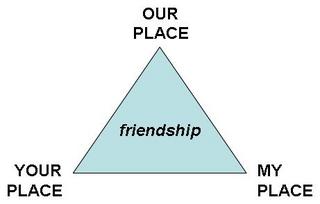 In my view a well developed friendship requires that we spend time in three different places, let me explain.
In the diagram you will notice that there are three places, “Your Place”, “My Place” and “Our Place”.
Most attenders of this church only know each other in the “Our Place” of the CMP building. For your relationship to move from acquaintance to friendship I believe that you need to make sure to spend some time at “My Place”, perhaps by inviting someone for lunch, and also some time at “Your Place” by being invited into someone else’s places.
Why is this important? Because when we spend time with people in different “places” we discover much more about the other person and they discover more about us.
I want to encourage and challenge you to spend some time thinking about who you could invite into your own space, somewhere outside of this building, and be willing to respond positively to invitations from others to enter their space. As we do this we move from acquaintance to friendship and in the process we become the body of God that he has called us to be.
 In my view a well developed friendship requires that we spend time in three different places, let me explain.
In the diagram you will notice that there are three places, “Your Place”, “My Place” and “Our Place”.
Most attenders of this church only know each other in the “Our Place” of the CMP building. For your relationship to move from acquaintance to friendship I believe that you need to make sure to spend some time at “My Place”, perhaps by inviting someone for lunch, and also some time at “Your Place” by being invited into someone else’s places.
Why is this important? Because when we spend time with people in different “places” we discover much more about the other person and they discover more about us.
I want to encourage and challenge you to spend some time thinking about who you could invite into your own space, somewhere outside of this building, and be willing to respond positively to invitations from others to enter their space. As we do this we move from acquaintance to friendship and in the process we become the body of God that he has called us to be.
wisdom in partnership
I make decisions fast, my wife takes more time ... I've come to the conclusion that she is for the most part a better decision maker.
I spend a lot of time considering our future financial state, my wife just deals with it day to day ... I've come to the conclusion that I'm better at looking after our financial situation.
I'm more rational, my wife more emotional ... I've come to the conclusion that both are necessary.
I love to start new things and take risks, my wife is more conservative ... I've come to the conclusion we make a good partnership.
Some people say marriage is a 50/50 thing, I say its a 100/100 arrangement where we both seek to give to the other 100% of who we are.
Some people say marriage is an old fashion thing, I say its the second best thing I ever did. (Best thing was deciding to be a follower of Jesus.)
Some people say we need to be independent, I say we need more interdependence.
Some people say life is what you make it, I say life is a precious gift given by God for which we should be profoundly grateful.
Some people say God is a crutch, I agree, but then a cripple needs a crutch and I'm not ashamed of my profound need for God.
I spend a lot of time considering our future financial state, my wife just deals with it day to day ... I've come to the conclusion that I'm better at looking after our financial situation.
I'm more rational, my wife more emotional ... I've come to the conclusion that both are necessary.
I love to start new things and take risks, my wife is more conservative ... I've come to the conclusion we make a good partnership.
Some people say marriage is a 50/50 thing, I say its a 100/100 arrangement where we both seek to give to the other 100% of who we are.
Some people say marriage is an old fashion thing, I say its the second best thing I ever did. (Best thing was deciding to be a follower of Jesus.)
Some people say we need to be independent, I say we need more interdependence.
Some people say life is what you make it, I say life is a precious gift given by God for which we should be profoundly grateful.
Some people say God is a crutch, I agree, but then a cripple needs a crutch and I'm not ashamed of my profound need for God.
Monday, June 27, 2005
poverty
Some people shake their heads in dispair, others turn their heads in shame, and some people put their heads together to make a difference. Check out http://www.makepovertyhistory.org to see how some people are seeking to really make a dent in the awful toll of poverty in the world.
getting in the way
Tom Peters in the foreward of his book Re-Imagine says "People ... in enterprise, in government ... are by and large well intentioned. They'd like to get things done. To be of service to others. But they're thwarted ... at every step of the way ... by absurd organisational barriers ... and by the egos of petty tyrants (be they corporate middle managers, or army colonels, or school superintendents."
Wow! What a rant and a rave. It would be laughably emotive if it weren't so true.
As a leader I have to continually ask myself this question. "How am I getting in the way of my people getting the task done?"
Leadership is not just about getting new things started, it's also about getting rid of every barrier, small or large, that gets in the way of our people doing a fantastic job.
So today in a review meeting with one of my staff, one of my questions will be, "What do I need to do or stop doing to ensure you can do your job fantastically?"
Wow! What a rant and a rave. It would be laughably emotive if it weren't so true.
As a leader I have to continually ask myself this question. "How am I getting in the way of my people getting the task done?"
Leadership is not just about getting new things started, it's also about getting rid of every barrier, small or large, that gets in the way of our people doing a fantastic job.
So today in a review meeting with one of my staff, one of my questions will be, "What do I need to do or stop doing to ensure you can do your job fantastically?"
Thursday, June 16, 2005
logical arguement?
Here's an example of how logic can be flawed.
Imagine one person is chasing another person. The chasing person is twice as quick as the person being chased. How long does it take for the chasing person to catch the chased person?
Answer: Never!
Logic: If the chasing person is 10 metres behind the chased person, then when the chasing person has run 10 metres the chased person has run 5 metres and so still 5 metres ahead. When the chasing person has run the next 5 metres, the chased person has run 2.5 metres and so is still 2.5 metres ahead. When the chasing person has run the next 2.5 metres the chased person has run 1.25 metres and so is still 1.25 metres ahead. Continue this logically and the chasing person can never catch the chased person.
So be careful next time you make a decision based on a logical arguement!
Imagine one person is chasing another person. The chasing person is twice as quick as the person being chased. How long does it take for the chasing person to catch the chased person?
Answer: Never!
Logic: If the chasing person is 10 metres behind the chased person, then when the chasing person has run 10 metres the chased person has run 5 metres and so still 5 metres ahead. When the chasing person has run the next 5 metres, the chased person has run 2.5 metres and so is still 2.5 metres ahead. When the chasing person has run the next 2.5 metres the chased person has run 1.25 metres and so is still 1.25 metres ahead. Continue this logically and the chasing person can never catch the chased person.
So be careful next time you make a decision based on a logical arguement!
big question
Here is a big question. It is an oldie but a goodie.
"What would I try if I knew I could not fail?"
Answer this and it might just change your life!
"What would I try if I knew I could not fail?"
Answer this and it might just change your life!
exam questions
My last blog on questions reminded me that I've passed many an exam or written many a speech just by asking the old familar questions of ... Who? What? When? How? Why?
Here's an experiment to try:
In your next conversation see how many questions you can ask. Then take time afterwards to reflect on how the conversation was different from the ones that you talk alot in.
Here's an experiment to try:
In your next conversation see how many questions you can ask. Then take time afterwards to reflect on how the conversation was different from the ones that you talk alot in.
what if?
Questions are powerful. Just listening to a Philosophy lecture on Plato's Republic and how Socrates was so influential precisely because he asked questions, particularly questions without a 'correct' answer that is implied.
Just started reading "Zap the Gaps" by K Blanchard & others, and he talks about not going to the solution too quickly, that is to spend time trying to ascertain the real root of the problem, and this implies the need to ask questions.
Some of the questions I'm mulling over at present are ...
"What if there isn't a God?" and the followup is ... "What other explanations for what is here, is there?"
"Am I guilty or am I just guilty of guilt?" (This comes from Francis Schaeffer and I'll explain it one day.)
"How do I change my habits?"
"Is what I'm doing worth it?"
"Why?" (This is one of my favourite questions.)
Just started reading "Zap the Gaps" by K Blanchard & others, and he talks about not going to the solution too quickly, that is to spend time trying to ascertain the real root of the problem, and this implies the need to ask questions.
Some of the questions I'm mulling over at present are ...
"What if there isn't a God?" and the followup is ... "What other explanations for what is here, is there?"
"Am I guilty or am I just guilty of guilt?" (This comes from Francis Schaeffer and I'll explain it one day.)
"How do I change my habits?"
"Is what I'm doing worth it?"
"Why?" (This is one of my favourite questions.)
Tuesday, June 14, 2005
the 'one minute manager'
For the last 15 years I've read alot of stuff on leadership. Recently I reread a classic called "The One Minute Manager" and have decided to do something different.
Instead of continuing to read new stuff I'm going to concentrate on applying the old stuff.
My goals are this ...
(1) Reread "The One Minute Manager" ten times. (It's only a small book)
(2) Work through the book with one of my team and apply the lessons as we go.
I'm discovering more and more that the problem is not innovative new ideas, its simply applying what we already know.
Instead of continuing to read new stuff I'm going to concentrate on applying the old stuff.
My goals are this ...
(1) Reread "The One Minute Manager" ten times. (It's only a small book)
(2) Work through the book with one of my team and apply the lessons as we go.
I'm discovering more and more that the problem is not innovative new ideas, its simply applying what we already know.
small groups
In my view belonging to a vibrant small group is one of the most important things you can do with your time. If you are serious about growing as a passionate, vibrant and holy disciple of Jesus then you need to be in a good small group.
Here are seven things that are best done in a small group. (1) Making friends. (2) Learning to pray. (3) Using your spiritual gifts. (4) Putting into practice what the bible teaches. (5) Learning to love fellow followers of Jesus. (6) Discovering your spiritual gifts. (7) Feeling welcome and loved.
There are groups meeting on Monday and Tuesdays so why not check them out this week. Or if you would like to start a new group then I’d love to help you start a new group.
Pastor Pete
Here are seven things that are best done in a small group. (1) Making friends. (2) Learning to pray. (3) Using your spiritual gifts. (4) Putting into practice what the bible teaches. (5) Learning to love fellow followers of Jesus. (6) Discovering your spiritual gifts. (7) Feeling welcome and loved.
There are groups meeting on Monday and Tuesdays so why not check them out this week. Or if you would like to start a new group then I’d love to help you start a new group.
Pastor Pete
role of fathers
In spiritual matters, kids take their cues from Dadby David Murrow
You've heard it said that fathers are the spiritual leaders of the home. Now there's a study to prove it.
Researchers from Switzerland examined whether parents' religious habits were transmitted to their offspring. They studied different variables, but one critical factor towered above the rest: the practices of the father determine whether children grow up attending church or not. And here's the shocker: the habits of the mother have almost no influence over their kids' future devotion.
Consider these findings:
When Mom is a regular churchgoer but Dad attends infrequently, just 3 percent of their kids go on to become regular churchgoers.
When Mom is regular but Dad never attends, just 2 percent become regular attenders.
Now, let's flip the chart. What if Dad is faithful?
When both Mom and Dad attend church regularly, 33 percent of kids grow up to attend regularly.
When Dad is regular but Mom only goes once in a while, the figure jumps to 38 percent.
Here's the real bombshell: when Dad is faithful but Mom never attends, 44 percent of the kids end up as regular church attenders!
Bottom line: in spiritual matters, kids take their cues from Dad. If Papa doesn't go to church, chances are very slim that his children will become regular worshippers. If the kids see religion as "Mom's thing" they are more likely to become disenchanted. But if Dad leads by example, children are twenty-two times more likely to become lifelong churchgoers.
You've heard it said that fathers are the spiritual leaders of the home. Now there's a study to prove it.
Researchers from Switzerland examined whether parents' religious habits were transmitted to their offspring. They studied different variables, but one critical factor towered above the rest: the practices of the father determine whether children grow up attending church or not. And here's the shocker: the habits of the mother have almost no influence over their kids' future devotion.
Consider these findings:
When Mom is a regular churchgoer but Dad attends infrequently, just 3 percent of their kids go on to become regular churchgoers.
When Mom is regular but Dad never attends, just 2 percent become regular attenders.
Now, let's flip the chart. What if Dad is faithful?
When both Mom and Dad attend church regularly, 33 percent of kids grow up to attend regularly.
When Dad is regular but Mom only goes once in a while, the figure jumps to 38 percent.
Here's the real bombshell: when Dad is faithful but Mom never attends, 44 percent of the kids end up as regular church attenders!
Bottom line: in spiritual matters, kids take their cues from Dad. If Papa doesn't go to church, chances are very slim that his children will become regular worshippers. If the kids see religion as "Mom's thing" they are more likely to become disenchanted. But if Dad leads by example, children are twenty-two times more likely to become lifelong churchgoers.
Thursday, April 14, 2005
learning
I love to learn. Some of this I do formally through University, some my own reading, and recently via a set of CD's I picked up from www.teach12.com.
Recently I picked up a series of teaching called "Great Ideas of Philosophy" and am finding it an incredible experience to delve into the great thinkers and their views about reality.
I never knew there was so much written about seemingly useless thoughts like, "How do I really know I exist?"
As I get older I'm more and more finding that I like to read things that challenge my particular paradigm of the world.
It's easy to get into the habit of only seeking out information that fits my own perspective. That is to read Christian books, magazines, websites etc. That's not wrong per see, but when it is all I read then I fall into a partern of easy thinking rather than exercising my mind to get a wider perspective.
What book or course could you take to widen your perspective?
Recently I picked up a series of teaching called "Great Ideas of Philosophy" and am finding it an incredible experience to delve into the great thinkers and their views about reality.
I never knew there was so much written about seemingly useless thoughts like, "How do I really know I exist?"
As I get older I'm more and more finding that I like to read things that challenge my particular paradigm of the world.
It's easy to get into the habit of only seeking out information that fits my own perspective. That is to read Christian books, magazines, websites etc. That's not wrong per see, but when it is all I read then I fall into a partern of easy thinking rather than exercising my mind to get a wider perspective.
What book or course could you take to widen your perspective?
Tuesday, March 29, 2005
tribute to wendy jamieson
To live well is a good thing, to die well is even better.
Over the weekend I had the priviledge of sharing in the final hours in the life of one of Gods' children and it was a time I will never forget. She was surrounded by people who shared her love for Jesus and who though sad had a sense of hope and peace that we will meet again.
Wendy's last days were a testimony to the love she had for her Saviour, Lord and God. Her thoughts were of others and how they to might know the incredible love of the Lord Jesus Christ.
The death of Wendy has reminded me of funerals that I have been to where there was no hope. Where people put on a brave face, made lovely tributes, tried to joke and laugh, but where there was a sense of finality about death.
The scriptures tell us that death is but the end of our life on earth, that for those that love and follow Jesus that it is the entry door into eternity. And it is this hope that takes the victory out of the hands of death and places it back into the hands of believers.
Is this just the hope of a people who cannot face the ultimate reality of death? No, I don't believe so.
There is a song that has a line "my redeemer lives", this is the hope of us who follow in the footsteps of Jesus Christ. Jesus, who history tells us was the greatest of all moral teachers, was also the one that paid for my sin on the cross of calvary and who was raised from death to prove that death is not the end.
Jesus lives and so my hope of life eternal is secure and one day I will meet face to face those who died in faith before me.
Over the weekend I had the priviledge of sharing in the final hours in the life of one of Gods' children and it was a time I will never forget. She was surrounded by people who shared her love for Jesus and who though sad had a sense of hope and peace that we will meet again.
Wendy's last days were a testimony to the love she had for her Saviour, Lord and God. Her thoughts were of others and how they to might know the incredible love of the Lord Jesus Christ.
The death of Wendy has reminded me of funerals that I have been to where there was no hope. Where people put on a brave face, made lovely tributes, tried to joke and laugh, but where there was a sense of finality about death.
The scriptures tell us that death is but the end of our life on earth, that for those that love and follow Jesus that it is the entry door into eternity. And it is this hope that takes the victory out of the hands of death and places it back into the hands of believers.
Is this just the hope of a people who cannot face the ultimate reality of death? No, I don't believe so.
There is a song that has a line "my redeemer lives", this is the hope of us who follow in the footsteps of Jesus Christ. Jesus, who history tells us was the greatest of all moral teachers, was also the one that paid for my sin on the cross of calvary and who was raised from death to prove that death is not the end.
Jesus lives and so my hope of life eternal is secure and one day I will meet face to face those who died in faith before me.
Wednesday, March 23, 2005
prayer is a funny thing
Frankly, I can't work God out sometimes, and that is probably a good thing.
I've discovered that when I pray that for some bizarre reason God takes about 3 months before answering my prayer. This is not true for others that I talk to, but it seems to have been a constant feature of my journey with God.
For example about three months ago I was praying that I would become a person who was happy, encouraging and able to listen. I don't feel that way very much, but in the last week I've had a significant number of people mention those exact characteristics.
Why does God take this amount of time to answer my prayer? I really have no idea. I personally would prefer it was more immediate, but I'm getting used to a very radical idea, the idea that God actually knows better than me.
I've discovered that when I pray that for some bizarre reason God takes about 3 months before answering my prayer. This is not true for others that I talk to, but it seems to have been a constant feature of my journey with God.
For example about three months ago I was praying that I would become a person who was happy, encouraging and able to listen. I don't feel that way very much, but in the last week I've had a significant number of people mention those exact characteristics.
Why does God take this amount of time to answer my prayer? I really have no idea. I personally would prefer it was more immediate, but I'm getting used to a very radical idea, the idea that God actually knows better than me.
Friday, March 18, 2005
kids
There is an excellent kids website at http://www.kids4truth.com/hometwo.asp. Lots of good stuff to check out. I've made it our homepage at home so that whenever the kids logon they are encouraged to deepen their own faith.
Thursday, March 10, 2005
money III
Just read a very interesting series of sermons by John MacArthur on money available from http://www.msreaderbooks.com/. Part of his premise is that how we use and deal with money is a reflection of our spirituality and I think he is right.
I enjoy his balance when he talks about how money is not good or bad, it is how it is used or misused that is the critical issue.
Why not check out his messages and consider the place of money in your life.
(Please note that a recommendation of his messages on money doesn't imply I agree with all of his views on all topics, but I find him a refreshing and challenging writer who makes me delve more deeply into the Word of God.)
I enjoy his balance when he talks about how money is not good or bad, it is how it is used or misused that is the critical issue.
Why not check out his messages and consider the place of money in your life.
(Please note that a recommendation of his messages on money doesn't imply I agree with all of his views on all topics, but I find him a refreshing and challenging writer who makes me delve more deeply into the Word of God.)
Saturday, March 05, 2005
dilbert
And if you enjoy Dilbert cartoons then check this out http://www.unitedmedia.com/comics/dilbert/
peanuts
Just having a fluff around the internet checking to see if I can find anything interesting. If you are a fan of Peanut comic strips then check out this website http://www.unitedmedia.com/comics/peanuts/
Thursday, February 24, 2005
jesus fact or fiction?
The http://www.jesusfactorfiction.com/ is an excellent resource for exploring who Jesus is. Lots of questions are answered by use of video clips so you need a decent internet speed for best results.
Monday, February 21, 2005
Saturday, February 19, 2005
that's my king
Do you want some inspiration? Go and check out the video clip called "That's My King" at www.sermonspice.com. You can check out a preview clip.
This clip reminds me of the awesomeness our my God. I've already shared it with others and it inspired and encouraged them as well.
This clip reminds me of the awesomeness our my God. I've already shared it with others and it inspired and encouraged them as well.
video clips
I was looking for good video clips for sermons and came across a brilliant site called www.sermonspice.com. The clips cost but they are very good. Before paying you can check them out online.
Friday, February 18, 2005
i don't find faith easy
I envy those people that find it easy to believe. For me the journey of faith is a rocky one. There are moments when I am really unsure and then there are moments I feel certain, but the certain moments are not as often as I would like.
I often cry out to God that he would reveal himself in a sign of some kind, but to date this has not happened.
I hear amazing testimonies of answered prayer from people I respect and believe and yet I still harbour a cynical side.
The part of the bible that most resonates with me is the phrase, "I believe, help my unbelief."
My prayer today is this, "Lord thank you that you hold on to me even in my moments of doubt, help me know you more and more so that my knowing you would encourage others to walk with you as well."
I often cry out to God that he would reveal himself in a sign of some kind, but to date this has not happened.
I hear amazing testimonies of answered prayer from people I respect and believe and yet I still harbour a cynical side.
The part of the bible that most resonates with me is the phrase, "I believe, help my unbelief."
My prayer today is this, "Lord thank you that you hold on to me even in my moments of doubt, help me know you more and more so that my knowing you would encourage others to walk with you as well."
temptation
Temptation can hit out of the blue. Had a situation tonight where I felt like a huge wave of temptation. Decided instead of giving in I would ask for help and so sent a text message to a friend that said, "Feeling tempted, please pray."
As soon as the text message had gone I felt the urgency of the burden leave. Then within minutes my friend rang and prayed with me over the phone.
I now understand a bit more of the truth of sharing our burdens with one another.
At the moment of temptation we have a choice to make, to give in or to reach out. I encourage you to both reach out to a friend and reach up to God, this two way reach is a temptation killer.
As soon as the text message had gone I felt the urgency of the burden leave. Then within minutes my friend rang and prayed with me over the phone.
I now understand a bit more of the truth of sharing our burdens with one another.
At the moment of temptation we have a choice to make, to give in or to reach out. I encourage you to both reach out to a friend and reach up to God, this two way reach is a temptation killer.
Subscribe to:
Posts (Atom)